Giảm giá hấp dẫn cho tour du lịch!



BÁI ĐÍNH PAGODA: THE GIANT OF THE EAST
A tale of two scales: One is the record-breaking grandeur of the largest pagoda complex in Southeast Asia, the other is the ancient, moss-covered silence of a mountain grotto. Discover why Bái Đính is a bridge between the spiritual ego of the present and the medicinal soul of the past.
NINH BINHLOCAL EXPERIENCES
Tobin Nguyen
1/23/20264 phút đọc
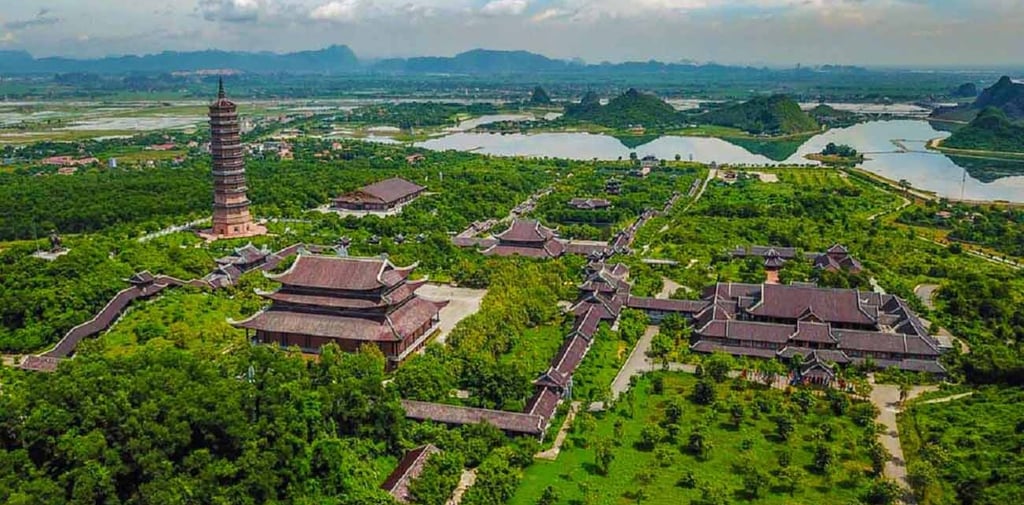
If Tam Cốc is a journey through the horizontal veins of the earth, then Bái Đính Pagoda is a vertical ascent toward the divine. Sprawling over 500 hectares of the Gia Sinh hills, this is not just a temple; it is a spiritual city. For many travelers, the sheer scale of the "New Bái Đính" can be overwhelming—a sprawling landscape of golden Buddhas, soaring bell towers, and corridors that seem to stretch into infinity. But for the "Insider," Bái Đính is a psychological journey. It is a place where modern Vietnam’s desire for greatness meets the ancient, humble roots of mountain worship. To truly understand this "Giant of the East," you must navigate the tension between the massive monuments of today and the hidden caves where the mountain’s heart has been beating for a thousand years.
1. The Corridor of 500 Arhats: A Marathon of Stone and Soul
Your journey into the New Bái Đính complex begins with the Arhat Corridor (La Hán). This is the longest of its kind in Asia, two parallel hallways that flank the central axis of the pagoda, housing 500 life-sized statues of Arhats, each carved from monolithic Ninh Bình stone. As you walk this nearly three-kilometer path, pay attention to the statues. No two are alike. One smiles with celestial joy, another frowns in deep meditation, and another seems to be in a state of fierce debate.
It is a "Visual Slap" of repetition and variety. Local pilgrims touch the knees and hands of these stone figures for luck, polishing the gray stone to a mirror-like shine over the years. Walking this corridor is a meditative exercise; the rhythmic architecture forces you to slow your pace, preparing your mind for the staggering scale of the bronze giants that wait at the top of the hill.
2. The Bronze Titans: Architecture of the Infinite
At the summit of the complex stand the great halls—the Tam Thế and the Pháp Chủ. Inside these structures, the air is thick with the scent of sandalwood and the low hum of chanting. Here, you encounter the giants: three 50-ton bronze Buddhas representing the past, present, and future, and a 100-ton statue of Gautama Buddha that holds the record as the largest in Asia.
Looking up at these golden titans, you feel the "Smallness" that the architecture intends. The ceilings are dizzyingly high, supported by massive pillars of ironwood, creating a sense of space that feels more like a celestial palace than a traditional Vietnamese pagoda. But look closer at the details—the intricate lotus patterns on the pedestals and the thousands of miniature Buddha statues that line the walls. This is the Dual Heritage of the modern era: using the immense scale of the 21st century to house a philosophy that has remained unchanged since the time of King Đinh.
3. The Ancient Grotto: Where the Medicine King Healed an Empire
While the New Bái Đính is about grandeur, the Ancient Bái Đính Pagoda—located on the slope of the same mountain—is about intimacy and mystery. This is the "Old Soul" of the complex, dating back to the 11th century. To reach it, you must walk past the bronze towers and enter a series of caves that breathe with the damp, cool air of the mountain.
This cave is where Nguyễn Minh Không, the legendary monk and "Medicine King" of the Lý Dynasty, once meditated and gathered herbs to cure the King’s mysterious illness. The statues here are not made of gleaming bronze; they are carved from the living rock of the cave, covered in a green patina of moss and time. In the "Bright Cave" (Hang Sáng), the light of heaven filters through the entrance to illuminate the Buddhas, while in the "Dark Cave" (Động Tối), the flickering candles create a world of shadows and incense. This is the true heartbeat of the mountain—a reminder that before there were golden halls, there was only the stone and the seeker.
4. The Bell Tower and the Stupa: The Sound and the View
No visit to Bái Đính is complete without standing beneath the Great Bell. Weighing 36 tons and cast in bronze, it is the voice of the valley. When struck, the sound carries for miles, a deep, resonant vibration that echoes off the limestone karsts, calling the faithful to prayer. It is a sound that connects the earth to the sky.
Rising above everything is the Bao Thien Stupa, a 13-story tower that serves as a lighthouse for the soul. If you take the elevator to the top, you are rewarded with a 360-degree panorama of the Ninh Bình landscape. From here, the massive temple complex below looks like a game of chess played by gods, surrounded by the emerald fields and the jagged limestone teeth of the horizon. It is the ultimate perspective: seeing the intersection of human ambition and natural beauty.
The Journalist's Epilogue:
Bái Đính Pagoda is a place of contradictions. It is both new and ancient, loud and silent, massive and intimate. It is a testament to the Vietnamese spirit—a nation that respects its humble roots in the caves but is not afraid to build monuments that touch the clouds. Next time you walk the Arhat Corridor, don't just count the statues. Think of the Medicine King in his dark cave and the 100-ton Buddha in his golden hall. They are two sides of the same coin, reminding us that the path to the divine begins with a single step on a mountain path.
We are on social media
Vietnam Charm belongs to Vietpearl Travel., JSC
Contact:
Email: info@vietnamcharm.top
© 2026. by Vietnam Charm. All rights reserved
Travel license number: 01-827/2020
Refund Policy