Giảm giá hấp dẫn cho tour du lịch!



BÍCH ĐỘNG PAGODA: THE THREE-TIERED STAIRWAY TO NIRVANA
A tale of vertical faith: Discover why an 18th-century king named this the "Second Most Beautiful Cave in Vietnam." This isn't just a temple; it’s a journey through the mountain’s belly, where the incense of the ancients meets the emerald light of the valley.
NINH BINHLOCAL EXPERIENCES
Tobin Nguyen
1/23/20263 phút đọc
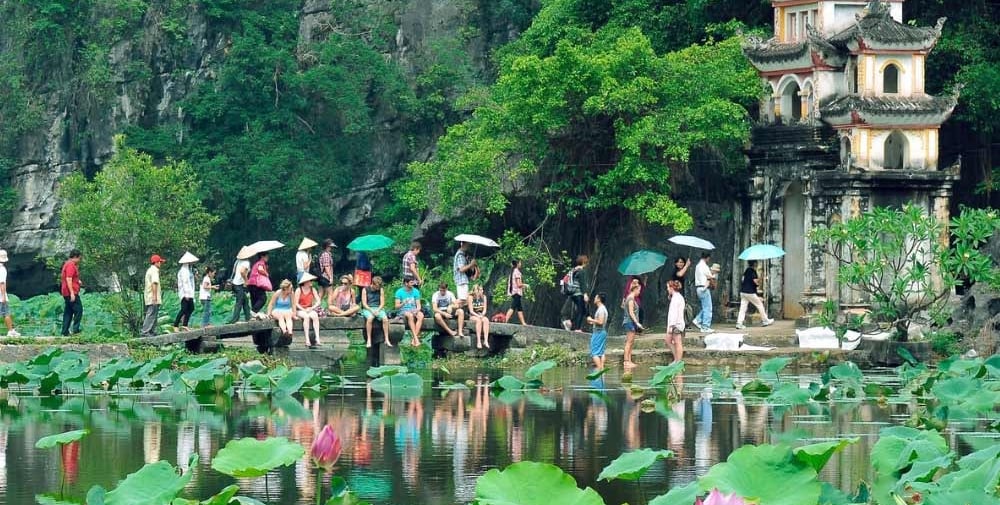
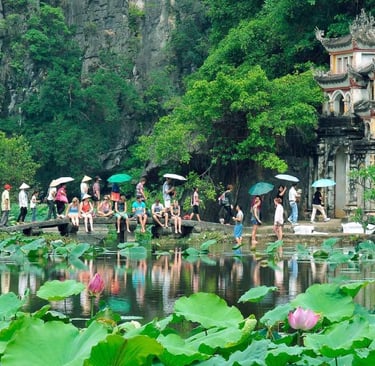
If Tràng An is a labyrinth of water, then Bích Động Pagoda is a labyrinth of spirit. Most travelers recognize it from the iconic stone bridge and the moss-covered gate that guards the base of the mountain—a scene so perfectly framed it has become the face of Ninh Bình on a thousand postcards. But Bích Động is a place that punishes the superficial. If you only take a photo at the gate and turn back, you have missed the entire point of the mountain. Bích Động is designed as a physical and spiritual ascent, a series of three pagodas built into the vertical cliffs, each one higher, darker, and more intimate than the last.
1. The Lower Pagoda: The Gateway of Earthly Grace
Your journey begins at the Chùa Hạ (Lower Pagoda). Set against the foot of the mountain, this temple feels like it is being slowly embraced by the limestone. The architecture is classic Vietnamese—curved tiled roofs, massive ironwood pillars, and the heavy scent of burning joss sticks.
But look at the back of the temple. The walls aren't made of brick; they are the living rock of the mountain itself. The "Visual Slap" here is the contrast between the delicate, man-made carvings of the altars and the raw, unyielding power of the karst. This is the starting point of the "Dual Heritage" experience at Bích Động: a place where human faith doesn't compete with nature, but seeks shelter within it.
2. The Middle Pagoda: A Temple in the Mountain’s Throat
As you climb the steep stone steps toward the Chùa Trung (Middle Pagoda), the air grows cooler and the light begins to change. This is the most unique part of the complex—a temple half-exposed to the valley and half-hidden inside a massive grotto. To enter, you must walk through the "mouth" of the mountain.
Inside, the light filters through the cave entrance, hitting the golden statues of the Buddhas and creating a shimmering, ethereal glow. This is why King Tự Đức named this place the "Green Pearl" (Bích Động). The rocks inside the cave have a peculiar, dark emerald hue when the humidity is high. Above the altar, the stalactites hang like celestial chandeliers, dripping water into ancient stone basins. It is a place of deep, "mineral" silence—a silence that forces you to internalize your journey.
3. The Upper Pagoda: Touching the Sky
The final climb to the Chùa Thượng (Upper Pagoda) is the most grueling. The steps are worn smooth by the feet of pilgrims over the centuries, and the path narrows as you reach the summit. This temple is small, humble, and perched on the very edge of the mountain.
When you reach the top, you are rewarded with the "Insider’s" view of the Ninh Bình landscape. From here, you can see the vast "Thung Nắng" (Sunshine Valley) spread out below you—a sea of emerald rice paddies punctuated by the dark shadows of the limestone karsts. It is a moment of absolute clarity. You have moved from the earth (Lower Pagoda), through the darkness of the mountain (Middle Pagoda), to the light of the heavens (Upper Pagoda). This is the architectural representation of Buddhist enlightenment, carved directly into the landscape.
4. The Legend of the Bell and the Monk
Bích Động was founded in 1705 by two monks, Trí Kiên and Trí Thể, who wandered the country looking for a place that radiated spiritual energy. Legend says they followed a strange, glowing light that led them to this cave. They didn't just build a temple; they "woke up" the mountain.
Inside the Middle Pagoda, there is an ancient bronze bell. The locals say that when the bell is struck during a certain alignment of the moon, its sound doesn't travel through the air, but through the stone itself, vibrating all the way down to the roots of the mountain. It is a reminder that Bích Động is not a static monument; it is a living, breathing entity that has been a lighthouse for seekers for over three hundred years.
The Journalist's Epilogue:
Bích Động is the most misunderstood site in Ninh Bình because it is so beautiful that people forget to look deeper. It is not just a "photo op." It is a vertical pilgrimage that asks you to crawl through the dark to find the light.
Next time you stand at that iconic stone gate, don't just check your camera settings. Look up. Look at the three levels of faith rising above you. Bích Động is a reminder that the most beautiful pearls are always hidden deep inside the shell of the mountain.
We are on social media
Vietnam Charm belongs to Vietpearl Travel., JSC
Contact:
Email: info@vietnamcharm.top
© 2026. by Vietnam Charm. All rights reserved
Travel license number: 01-827/2020
Refund Policy