Giảm giá hấp dẫn cho tour du lịch!


CHAPTER 8: THE CHAMPA MYSTERY – DECODING THE SACRED MOTHER
"Behind the skyline of glass and steel lies a landscape of ancient brick and sacred whispers. Journey into the heart of the Champa Kingdom and discover why a Mother Goddess—not a King—rules the soul of this coast."
NHA TRANGSHORE EXCURSIONLOCAL EXPERIENCES
Tobin Nguyen
1/17/20264 phút đọc
Rising like jagged red crowns above the mouth of the Cai River, the Po Nagar Cham Towers are more than just ruins; they are active spiritual batteries. Built between the 7th and 12th centuries, this site was the spiritual heart of the Kauthara Principality—one of the four major territories of the Champa Kingdom. To the casual visitor, it is a beautiful photo opportunity. To the discerning traveler, it is an architectural and sociological enigma that holds the key to the region's identity.
In a world where modern cities are built in decades, Po Nagar has stood for over a millennium. It has survived the fall of empires, the arrival of new religions, and the relentless march of urbanization. To walk up the stone steps of Mount Cù Lao is to step out of the 21st century and into a realm where the laws of physics and the structures of society were fundamentally different.
1. The Alchemy of the Brick: Building Without Mortar
The first mystery that strikes every architect or engineer who visits Po Nagar is the masonry. As you stand at the base of the North Tower (Tháp Chính), the tallest and most imposing of the group, look closely at the joints between the bricks. There is no visible mortar. No cement, no thick layers of lime, no gaps where the elements could seep in.
For decades, the "Champa Brick" has been a subject of intense scientific debate. How did a civilization over a thousand years ago create structures that withstand the relentless humidity, salt air, and tropical typhoons of the Central Vietnamese coast?
The Fusion Theory: Modern chemical analysis suggest that the Cham did not "glue" their bricks together in the way we understand masonry today. Instead, they used a sophisticated "cold-fusion" technique. They would use a thin, translucent film of organic resin—extracted from the Dầu Rái tree—and literally rub the bricks together until they were perfectly flush. This friction, combined with the resin, created a chemical bond so tight that the air was squeezed out. When you touch these walls, you aren't touching a stack of individual bricks; you are touching a single, solid piece of history.
The Lost Art of Durability: Even more fascinating is the composition of the bricks themselves. They are lighter and more porous than modern industrial bricks, yet far more durable. While the ornate sandstone carvings have weathered away into soft, ghostly shapes, the bricks remain sharp and vibrant. They "breathe" with the humidity, expanding and contracting without cracking. This is an ancient "Smart Material" that modern technology still fails to replicate perfectly.
2. The Matriarchal DNA: Why the Mother Rules
Unlike many of the world’s ancient empires—from the Romans to the Khmers—that glorified warrior-kings and patriarchal lineages, the Champa civilization was profoundly matriarchal. Power, heritage, and spirituality flowed through the female line.
The supreme deity here is not a male god of war, but Yan Po Nagar, the Mother Goddess of the Kingdom. According to Cham legend, she was born from the clouds and the seafoam. She didn't descend to earth to conquer; she came to teach. She is credited with showing the people how to cultivate rice, how to weave silk, and how to organize the laws of a fair society.
The Inner Sanctum: When you enter the dark, cool inner sanctum of the main tower, the atmosphere shifts instantly. The smell of sandalwood is thick, and the light is provided by flickering candles. You won't find a statue of a fierce king. You will find the Mother Goddess, carved from black stone, seated in a pose of immense calm. In Nha Trang, female energy is the foundation. The "Mother" remains the protector of the fishermen and the silent CEO of the city's spiritual life.
3. The Sensory Theater: Incense, Mudras, and the Shadow Dance
To visit Po Nagar without experiencing its sensory rituals is to see a body without a soul. The site is a living theater where ancient traditions are performed daily.
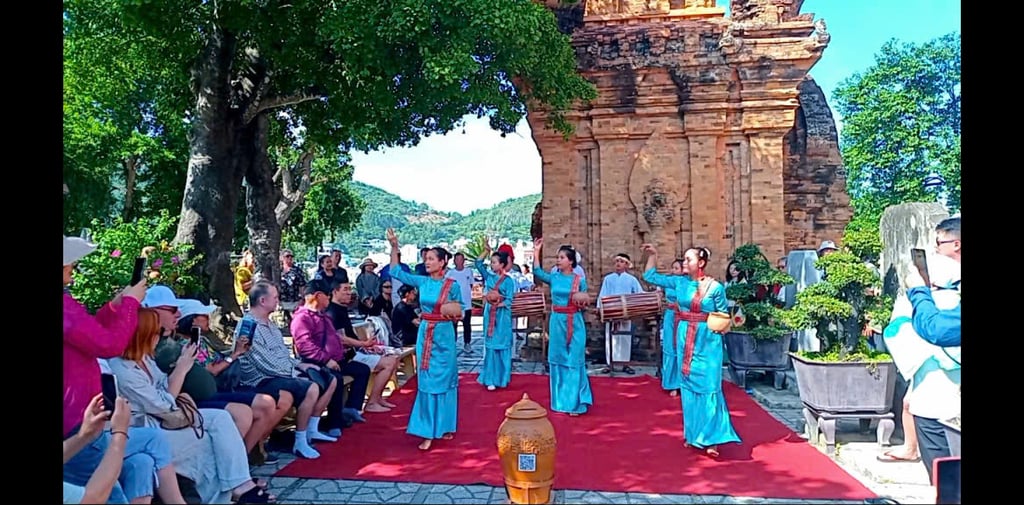
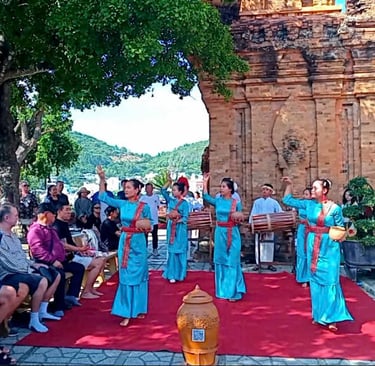
The "Múa Chăm" (Cham Dance): In the front courtyard, you may witness the Cham Dance. The dancers move with a fluid, slow-motion grace that feels hypnotic. Their hands form intricate mudras—symbolic gestures—that mirror the thousand-year-old carvings on the walls. Notice the porcelain vases balanced on their heads; this is a tribute to the "Water-Bearing" heritage of the Cham women.
The Scent of Sandalwood: The air at Po Nagar is heavy with the scent of burning sandalwood and fresh jasmine. For the Cham, incense is the "Messenger of the Soul." Each puff of smoke carries a prayer from the earth to the Goddess. Joining a local family in offering a simple bunch of flowers or lighting a stick of incense is the fastest way to bridge the gap between "tourist" and "guest."
4. The Engineering of the Hill: A Sacred Geometry
The placement of the towers is not accidental. The Cham were masters of integrating nature and the cosmos. Mount Cù Lao was chosen because it sits at the meeting point of the mountain, the river, and the sea. The towers are oriented toward the East, facing the rising sun, symbolizing the constant renewal of life. From the top of the hill, you can see the Cai River flowing into the sapphire bay. The Cham believed that the river brought the wisdom of the mountains down to the sea, and the Goddess stood at the gate to manage that energy.
5. Tactical Exploration: How to Experience the Mystery
To find the "Mystery" amidst the noise, one must be tactical.
The Twilight Window: Most large tour buses depart by 4:30 PM. Between this time and sunset, the light undergoes a dramatic transformation. The tropical sun hits the red bricks, turning the entire hill into a glowing, molten ember.
The "Bottom-Up" Perspective: Before you climb, spend time at the "Mandapa" (the forest of octagonal columns at the base). These pillars once supported a massive roof where pilgrims would prepare themselves.
Professional Narration: To the untrained eye, a brick is just a brick. But to an expert, every carving tells a story of astronomy and religion. Exploring with a vetted guide or a professional audio tour is essential.
ANCESTRAL BLOOD: CHAMPA EXPLORATION
Champa Heritage Tours (Klook/GYG): Vetted specialist guides and private sunset experiences. 👉 [Insert Link Here]
Vietnamcharm Signature Walk: Free walking tours & professional audio guides for heritage lovers. 👉 [Insert Link Here]
RECOMMENDATIONS
We are on social media
Vietnam Charm belongs to Vietpearl Travel., JSC
Contact:
Email: info@vietnamcharm.top
© 2026. by Vietnam Charm. All rights reserved
Travel license number: 01-827/2020
Refund Policy