Giảm giá hấp dẫn cho tour du lịch!



CHEO, XAM, AND VAN: THE SACRED TRINITY OF THE NORTHERN SOUL
A tale of three echoes: One is the imperial grace of the Opera born in the King’s court, one is the gritty blues of the blind busker, and the last is the trance-inducing rhythm of the gods. Discover why Ninh Bình is the "Cradle of Chèo" and how its music acts as a bridge between the living, the dead, and the divine.
NINH BINHLOCAL EXPERIENCES
Tobin Nguyen
1/23/20264 phút đọc
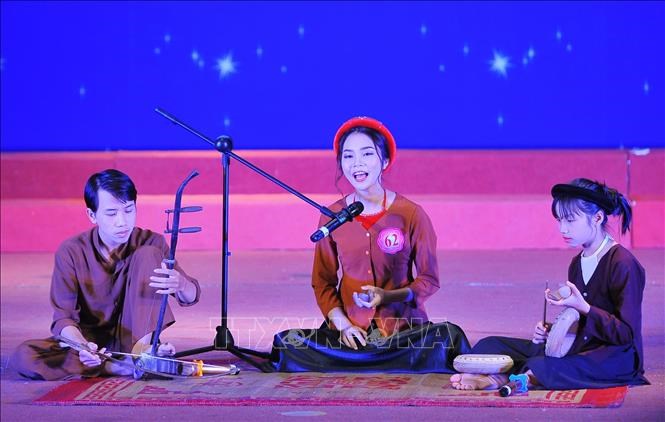
If the cuisine of Ninh Bình is the taste of the land, then its music is the "Sound of the Shadows." While the world moves toward the polished, digital sounds of the 21st century, in the quiet corners of this province, an ancient, acoustic vibration still lingers. It is a sound born from the dampness of the caves, the creak of the rowing oars, and the raw grit of human struggle. As a journalist tracking the "Oral History of the Karst," I’ve found that you haven't truly heard Ninh Bình until you’ve listened to Chèo, Xẩm, and Văn. These aren't just genres; they are the soundtracks to the "Dual Heritage"—representing the royal court, the dusty roadside, and the spiritual temple.
1. The Cradle of Chèo: The Legacy of the First Diva
Most people think of Chèo as a village opera from the Red River Delta, but its heart beats strongest in Ninh Bình. This is the birthplace of Phạm Thị Trân, the legendary woman who lived during the 10th-century Đinh Dynasty and is worshiped as the Ancestor of Chèo. She was the first to organize the imperial dance and singing troupes, turning the raw energy of folk songs into a sophisticated theater for the King’s court in Hoa Lư.
Chèo is a "Visual and Sensory Slap" of metaphor and movement. It is a lyrical theater where every tilt of the head, every flick of a silk fan, and every high-pitched vocal ornament tells a story of Confucian morality, tragic love, or biting social satire. Unlike Western opera, Chèo is interactive; the "audience" in the village square would shout back at the characters, blurring the line between the stage and life. In Ninh Bình, Chèo still feels "Imperial." When you hear a melody floating over the rice fields of Yên Khánh or Gia Viễn, you are hearing a sound that once echoed off the palace walls of Emperor Đinh Tiên Hoàng.
2. Hát Xẩm: The Blues of the Vietnamese Roadside
If Chèo is the royal theater, then Hát Xẩm is the music of the street and the market. Ninh Bình is the spiritual home of this art form, personified by the late Hà Thị Cầu, the "Last Xẩm Singer." Xẩm is the "Blues" of Vietnam—the music of blind musicians who sat on woven mats at crossroads, their only possessions a two-stringed fiddle (đàn nhị) and a bamboo drum.
Xẩm doesn't talk about kings; it talks about the pain of poverty, the bitterness of betrayal, and the dark humor of survival. The singing style is raw and gravelly, vibrating with a grit that mimics the struggle of the common man. The đàn nhị doesn't just play notes; it cries and mocks, its silk strings producing a "sobbing" sound that can break your heart. It is the sound of the "Soil"—a resilient, unpolished beauty that feels as weathered as the limestone cliffs of the province.
3. Hát Văn: The Hypnotic Gateway to the Gods
While Chèo and Xẩm are rooted in the human experience, Hát Văn is a ladder to the sky. This is the psychedelic music of the Hầu Đồng (Mother Goddess religion) rituals. If you walk into a hidden sanctuary in Tràng An during a ceremony, you are stepping into a "Sensory Overload" of red silks, thick incense, and trance-inducing rhythms.
Driven by the Đàn Nguyệt (moon-shaped lute) and a battery of drums, Hát Văn is designed to induce a spiritual trance. The rhythm is fast, syncopated, and incredibly complex. As the spirit medium dances to represent different deities, the music swells, getting louder and faster until the boundary between the human and the divine begins to blur. It is the sound of the "Spirit"—the part of the dual heritage that seeks to transcend the stone and the mud to touch the celestial.
4. The Echo That Won't Die: A New Generation
Today, the music of Ninh Bình is experiencing a rebirth. You can find young artists in the villages of Yên Mô or at the Bái Đính pagoda who are refusing to let these sounds vanish. They are bringing the imperial grace of Chèo back to the ancient temples and performing Xẩm on the very sampans that glide through the caves of Tam Cốc.
They are proving that the music of Ninh Bình is not a museum piece; it is a living, breathing entity. It is the "Voice in the Stone" made audible. When the fiddle of the Xẩm singer meets the silk fan of the Chèo performer and the hypnotic drum of the Văn medium, the entire landscape of Ninh Bình comes alive. It is a reminder that as long as there is struggle, as long as there is grace, and as long as there is faith, the heart of the karst will never be silent.
The Journalist's Epilogue:
The Voices of the Shadows are what give Ninh Bình its emotional depth. Without the songs, the mountains are just rocks and the temples are just buildings. But when you hear the imperial cry of a Chèo melody or the gritty pulse of a Xẩm fiddle, the landscape transforms into a living epic.
Next time you are in Ninh Bình, don't just look for a photo op. Look for a performance in an old village đình (communal house) or sit quietly in a temple during a goddess ritual. Don't worry about the translation. Just feel the vibration in your chest. You’ll realize that the true heritage of this province isn't just something you see—it’s a sound as old as the mountains and as deep as the river, resonating in the very marrow of the Vietnamese soul.
We are on social media
Vietnam Charm belongs to Vietpearl Travel., JSC
Contact:
Email: info@vietnamcharm.top
© 2026. by Vietnam Charm. All rights reserved
Travel license number: 01-827/2020
Refund Policy