Giảm giá hấp dẫn cho tour du lịch!


DECODING THE SYMBOLIC USE OF HUE, GOLD, AND RED IN VIETNAMESE TRADITIONAL AND IMPERIAL ARCHITECTURE
More than aesthetics: exploring color as Việt Nam’s ultimate non-verbal spiritual and political language, analyzing how Ngũ Hành (Five Elements) dictates architectural palettes, and the profound emotional power embedded in the iconic yellow of Hội An and the solemn gold of Huế.
LOCAL EXPERIENCESVIETNAMESE CULTURETHE ARCHITECTURAL SOUL
Tobin Nguyen
11/6/20255 phút đọc
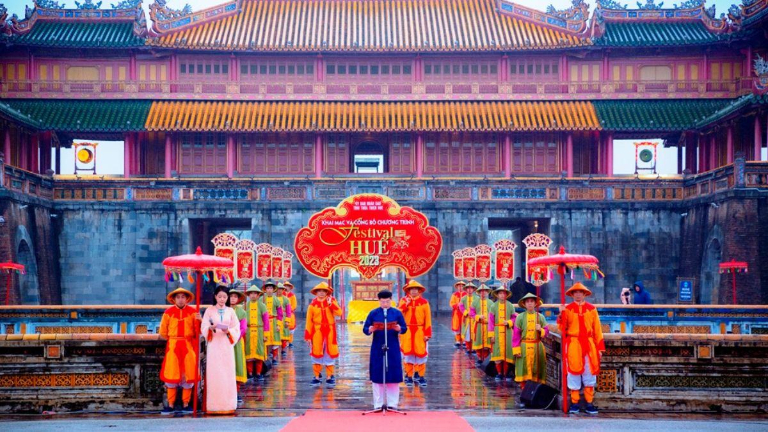
For the international observer, the visual experience of Việt Nam is a saturation of color—from the luminous amber of Hội An's old houses to the vibrant red and gold of temples and the intense greens of the tropical landscape. Yet, in Vietnamese architecture, color is rarely a casual choice; it is a highly sophisticated, deliberate, and non-verbal language—a profound cultural code rooted in ancient cosmology, spiritual belief, and political hierarchy. The specific use of hue, especially the dominance of yellow, red, and the nuanced application of dark wood, transforms the built environment into a continuous, visible statement of fortune, status, and historical memory.
As specialists in Vietnamese heritage and profound cultural analysis at Vietnam Charm, we embark on an essential, detailed exploration to decode this color code. We will meticulously analyze the cosmological principles of Ngũ Hành (Five Elements) that mandate architectural color schemes, the political power articulated by the imperial use of gold and yellow, the emotional resonance of the iconic colors of the Central Coast, and the profound way this disciplined palette articulates the core values of harmony, stability, and spiritual aspiration. Understanding the color code is essential to grasping the emotional and spiritual structure of Vietnamese space.
1. The Cosmological Foundation: Ngũ Hành and the Dictates of Balance
The supreme law governing color application in Vietnamese traditional architecture is the ancient Chinese-Vietnamese principle of Ngũ Hành (Five Elements): Wood, Fire, Earth, Metal, and Water. Each element is inextricably linked to specific colors, directions, and energies, and the correct usage is crucial for attracting fortune and ensuring spiritual balance.
This is not superstition; it is a profound, applied science of energy flow. A building, like an individual, must embody a harmonious balance of the Five Elements to thrive. The colors are deliberately used to strengthen or suppress specific energies within the space, often based on the owner's or the dynasty's elemental alignment.
Yellow (Vàng): Associated with the Earth element (Thổ). Yellow is the ultimate color of stability, nourishment, and centrality. In imperial contexts, it represents the Emperor, who is the "Son of Heaven" and the symbolic center of the Earth. Its gentle, warm hue also signifies prosperity and warmth, making it intensely popular for domestic and commercial facades, particularly in the Central region.
Red (Đỏ): Associated with the Fire element (Hỏa). Red is the most powerful color of vitality, good luck (Lộc), celebration, and passion. It is non-negotiable for all ritual occasions—Tết, weddings, and temple gates—as its presence is believed to scare away evil spirits and attract immediate, intense fortune. Its energy is protective and fiercely positive.
Black/Dark Brown (Đen/Nâu): Associated with the Water element (Thủy). Used extensively in ancient timber architecture, this color signifies depth, mystery, and wisdom. It creates a necessary Yin contrast to the bright Yang colors (Red and Yellow), providing the necessary balance and lending a sense of history and solemnity to the space.
The strategic application of this code ensures that the architecture is not merely pleasing to the eye, but is actively working to harmonize the flow of cosmic energy for the benefit of the occupants.
2. The Political Power: Gold, Imperial Yellow, and the Code of the Court
In imperial architecture, color transitioned from a functional tool of Feng Shui to a direct, uncompromising language of political power and hierarchy. The Nguyễn Dynasty in Huế utilized color to structurally enforce the Emperor's divine authority.
The dominant, defining hue of the Huế Imperial Citadel is Imperial Yellow and Gold. These colors were strictly reserved for the Emperor, symbolizing his unique, absolute status as the center of the Earth element and the highest political power. The sheer quantity of gold leaf and bright yellow paint used in the throne room (Điện Thái Hòa) and on the gates was intended to visually overwhelm and awe, leaving no doubt about the absolute supremacy of the sovereign. This usage was a conscious, deliberate assertion of power.
This political color code extended throughout the entire hierarchy:
Deep Purple/Violet: Often reserved for high-ranking mandarins and imperial family members, signifying nobility and wisdom, but always secondary to the Emperor's yellow.
Blue and Green: Used extensively on the tiled roofs and secondary gates, symbolizing the lower administrative ranks, wisdom, and the Wood element—the stability of the government bureaucracy that supports the central power.
This meticulous, disciplined application of color ensured that the entire complex was not only aesthetically magnificent but also a physical diagram of the political and social hierarchy, making the imperial architecture legible and immediately comprehensible to all visitors. The architecture's color spoke volumes about status, power, and the uncompromising order of the court.
3. The Central Coast's Amber Heart: The Emotional Resonance of Hội An Yellow
The most aesthetically and emotionally potent use of color in Vietnamese urban architecture is the signature Amber Yellow of the Hội An Ancient Town, a hue that has become synonymous with the spirit of the Central Coast.
The widespread use of this specific soft, warm yellow in Hội An is deeply resonant. Historically, the color was derived from natural ochre pigment mixed with lime wash, an affordable and durable technique suitable for the coastal climate. However, its enduring power lies in its emotional effect. The yellow hue is neither aggressive nor demanding; it is gentle, warm, and highly reflective. As the intense sunlight of the Central Coast strikes the walls, the yellow creates a continuous, soft, radiant amber glow, lending the town a profound sense of timelessness, stillness, and quiet melancholy. The color visibly arrests the speed of modern life.
The yellow of Hội An functions as a psychological anchor. It is the color of Earth (stability), and it perfectly balances the intense heat (Fire) of the sun and the vast blue (Water) of the river and sky. The complementary use of Red (in the silk lanterns and calligraphy) provides the necessary kinetic energy and luck (Lộc) against the stabilizing yellow, creating a perfect aesthetic and emotional equilibrium. The color makes the town feel both ancient and eternally welcoming, embodying the core values of tranquility and enduring charm.
4. The Enduring Contrast: Dark Wood, Light Brick, and the Balance of Âm-Dương
Beyond the dominant imperial and commercial colors, the structural aesthetic of traditional Vietnamese architecture relies heavily on the profound contrast between Dark Wood and Light Brick, an essential application of the Âm-Dương (Yin-Yang) philosophy.
The traditional Northern Nhà Cổ (Old Timber House) and the communal Đình often utilized dark, rich black or deep red timber (from durable, prized woods like ironwood) for the main pillars, beams, and structural elements. This dark, imposing wood signifies Âm (Yin)—stability, solemnity, and the ancestral past. The interior space is often dimly lit, emphasizing the wisdom and quiet contemplation associated with the shadow.
This dark structure is always contrasted and softened by the surrounding elements: the white or light-colored plaster walls or the red/yellow tiles that signify Dương (Yang)—light, vitality, and the present moment. The white wash provides the necessary visual relief and reflection of light. The seamless contrast between the dark, heavy timber frame (Yin) and the light, bright walls (Yang) is a deliberate, structural attempt to create perfect energy balance within the home, ensuring the occupants are protected by the deep wisdom of the past while participating healthily in the vitality of the present. The architecture uses color to affirm the essential cosmic duality.
5. Conclusion: The Emotional Map of the Nation
The color code of Vietnamese architecture is a masterful, profound language that transforms the built environment into a continuous, powerful expression of cosmology, history, and emotion. It is a visual testament to the national commitment to Ngũ Hành balance and spiritual clarity. By decoding the political authority of imperial gold, the stabilizing geometry of the Earth element (Yellow), the protective energy of Fire (Red), and the structural contrast of the Yin-Yang dark timber, the observer gains access to a core truth: in Việt Nam, color is never accidental. It is a deliberate declaration of identity, status, and aspiration. The vibrant palette is the nation’s emotional map, perpetually reminding the citizen that their daily life is structurally and spiritually anchored by the wisdom and discipline of ancient, enduring cosmic laws.
We are on social media
Vietnam Charm belongs to Vietpearl Travel., JSC
Contact:
Email: info@vietnamcharm.top
© 2026. by Vietnam Charm. All rights reserved
Travel license number: 01-827/2020
Refund Policy