Giảm giá hấp dẫn cho tour du lịch!



MUA CAVE NINH BINH: THE VERTICAL CONQUEST OF THE LYING DRAGON
A tale of two perspectives: One is the grueling, 500-step ascent that burns the lungs, the other is the god-like view of a golden empire that heals the soul. Discover why the "Dancing Cave" was the King’s private theatre and how to stand on the spine of a stone dragon to witness the heartbeat of Ninh Binh.
NINH BINHLOCAL EXPERIENCES
Tobin Nguyen
1/23/20264 phút đọc
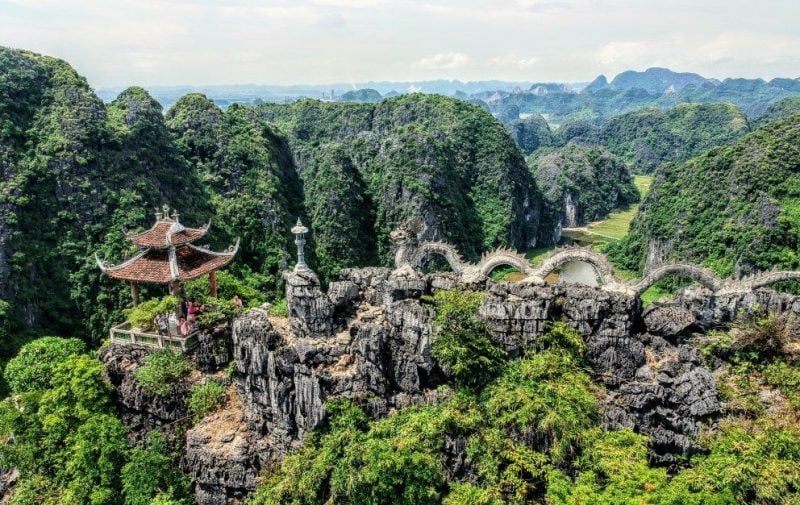
If the wetlands of Van Long are a whispered poem, then Mua Cave (Hang Múa) is a high-pitched operatic crescendo. Most travelers see the photos—the iconic jagged ridge, the stone dragon silhouette against a sunset, and the dizzying view of the Ngo Dong river winding through the rice fields—and they think they understand the place. But to truly experience Mua Cave, you have to earn it with your sweat and your breath. It is known as the "Great Wall of Vietnam," not because of its length, but because of its sheer, vertical defiance. Standing at the base and looking up at the 500 stone steps carved directly into the white limestone, you realize this isn't just a viewpoint; it is a stairway designed to separate the casual tourists from those who want to see the world as the ancient Kings did.
1. The Legend Behind the Name: Why is it Called the "Dancing Cave"?
The name "Hang Múa" translates literally to the "Dancing Cave," and its history is far more delicate than the brutal stone stairway suggests. Legend has it that when the Tran Dynasty moved their capital to this region in the 13th century, King Tran Thai Tong would often come to this specific cave to escape the pressures of the court. He used the cave at the base of the mountain as a natural amphitheater to watch his beautiful concubines and imperial troupes perform traditional dances.
The acoustics of the limestone cavern were so perfect that they amplified every note of the flute and every swirl of silk. Today, as you begin the ascent, you can almost hear the ghostly echoes of those performances beneath the heavy breathing of the modern-day climbers. It is a strange, beautiful irony: a place named after the grace of a dance, now famous for the grit of a climb that tests the limits of human endurance.
2. Climbing the 500 Steps: The Path to the Lying Dragon
The ascent of Mua Cave is a psychological game as much as a physical one. The steps are uneven, steep, and built in the traditional architectural style with low stone railings decorated with phoenixes and dragons. About halfway up, the path splits into two distinct directions. To the left is the lower peak, home to a graceful white stupa that looks like something out of a Himalayan dream. But it is the path to the right that leads you to the true "Lying Dragon" and the most iconic viewpoint in all of Ninh Binh.
As you reach the final 50 steps, the wind begins to pick up, carrying the scent of wet rice and wild mountain herbs. Your legs will burn, and your heart will drum against your ribs, but then you crest the final ridge, and the "Visual Slap" hits you. You find yourself standing on a narrow, jagged spine of rock where a massive stone dragon stretches across the peak, its tail rooted in the mountain and its head staring out over the vast, emerald kingdom of Tam Coc below. Standing here at sunset is a religious experience; the world below transforms into a silent, golden miniature of itself.
3. The Best View of Tam Coc: A Strategic Imperial Perspective
From the dragon’s back, the Ngo Dong river looks like a discarded silk ribbon, and the sampans moving along it are tiny as water striders. If you time your visit during the "Golden Season" in late May or early June, the entire valley turns into a sea of molten gold as the rice ripens for harvest. This is the view that made the Tran Kings realize they had found a Thánh địa—a sacred land.
But for the "Insider," this isn't just a pretty landscape; it is a strategic map of an empire. From this height, you can see how the natural fortress of the limestone mountains closes in on the valleys, creating a series of natural choke points. Every beautiful curve of the river was once a potential ambush point for an invading army. You aren't just looking at scenery; you are looking at the defensive heart of a nation that refused to be conquered for a thousand years.
4. Finding Solitude: The Insider's Secret to Mua Cave
The real secret of Mua Cave isn't just reaching the summit; it's the silence you find if you stay just a little longer than the crowds. As the sun dips behind the limestone karsts and the "selfie-stick" army begins their frantic descent, the mountain returns to its ancient self. The shadows of the stone dragon grow long and sharp across the white rock, and the heat of the day radiates back out of the mountain.
For a few fleeting minutes, you are alone on the stairway to the sky. It is in this moment that you understand why the Kings came here. It wasn't just for the theater or the defense; it was for the perspective. Mua Cave forces you to look down on the world’s chaos from a height of absolute, unmoving stone. It reminds you that while empires and dancers eventually vanish, the dragon remains, lying in wait for the next person brave enough to climb its spine and see the world through the eyes of a king.
The Journalist's Epilogue:
Mua Cave is the physical exertion that Ninh Binh demands of you. It is a reminder that the best views are never given—they are earned. Next time you stand on those 500 steps, don't rush. Feel the stone beneath your palms, listen for the echoes of the dancers in the wind, and look at the dragon not as a statue, but as a sentinel. You didn't just climb a hill; you conquered a piece of history.
We are on social media
Vietnam Charm belongs to Vietpearl Travel., JSC
Contact:
Email: info@vietnamcharm.top
© 2026. by Vietnam Charm. All rights reserved
Travel license number: 01-827/2020
Refund Policy