Giảm giá hấp dẫn cho tour du lịch!



NINH VÂN: THE VOICES IN THE STONE
A tale of two states: One is the cold, unyielding silence of the limestone cliff, the other is the breathing, soaring spirit of a carved dragon. Discover the master "Soul-Carvers" of Ninh Bình and why the history of Vietnam isn’t written in ink, but etched into the heart of the rock.
NINH BINHLOCAL EXPERIENCES
Tobin Nguyen
1/23/20264 phút đọc
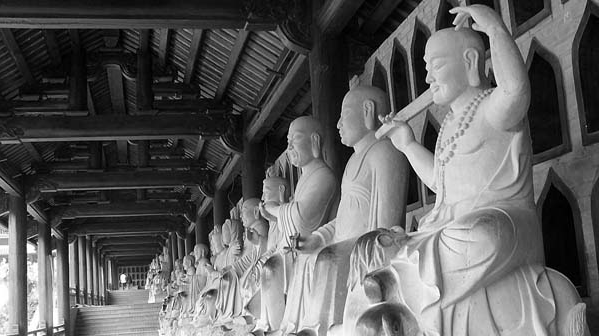
If the temples of Bái Đính and the cathedrals of Phát Diệm are the finished masterpieces of Ninh Bình, then Ninh Vân Village is the womb where they were born. As you ride into the district of Hoa Lư, the sound of the wind through the rice fields is suddenly replaced by a percussive, metallic symphony: the clink-clink-clink of thousands of chisels striking stone. Here, the dust of the mountains hangs in the air like a fine gray mist, coating the leaves of the trees and the skin of the men who work here. This is not just a workshop; it is a battlefield where humans wrestle with the earth to extract beauty from the grey abyss. In Ninh Vân, the mountains don't just stand still—they are transformed into gods, kings, and guardians.
1. The Lineage of the Lithic Masters
The story of Ninh Vân is as old as the mountains themselves. For over 400 years, the artisans of this village have been the "Hands of the Empire." It was their ancestors who were summoned by the kings of the Đinh, Lê, and Lý dynasties to build the citadels of Hoa Lư and the tombs of the royalty. In this village, stone carving isn't a job; it’s a genetic trait.
As a journalist walking through the open-air workshops, I see teenagers working alongside their grandfathers. The elders don't use blueprints; they have the proportions of a 10th-century dragon etched into their muscle memory. They can look at a raw, 10-ton block of limestone and "see" the lotus flower hidden inside it. To an outsider, it is a loud, dusty village. To an "Insider," it is a living library of Vietnamese aesthetics, where every strike of the hammer is a word in a 400-year-old sentence.
2. The Dialogue Between Steel and Stone
The process of turning a mountain into a monument is a brutal, beautiful dialogue. It begins with the "Selection"—finding the right "bone" of the mountain. Not all stone is equal; the artisans look for the "Blue Stone" (Đá Xanh) of Ninh Bình, famous for its durability, its fine grain, and the way it turns a deep, soulful charcoal when wet.
Once the block is chosen, the "Roughing" begins. This is the stage of raw power, where heavy machinery and sledgehammers break the mountain's initial resistance. But as the form emerges, the tools grow smaller and the touches grow lighter. This is when the "Soul-Carving" happens. Watching an artisan carve the scales of a dragon or the folds of a Buddha’s robe is a lesson in patience. There is no "undo" button in stone carving. One wrong strike, and a month of work is shattered. It is a high-stakes art form that demands a level of focus that is becoming extinct in our digital world.
3. Beyond Ninh Bình: The Granite Footprints of a Nation
You have already seen the work of Ninh Vân without even knowing it. When you stood in the shadow of the 500 Arhats at Bái Đính, you were looking at Ninh Vân. When you touched the "wood-like" stone panels of Phát Diệm Cathedral, you were touching the labor of these villagers. Their work is the "Skeleton" of Vietnamese culture.
But their influence goes far beyond the province. From the Ho Chi Minh Mausoleum in Hanoi to the heroic monuments in the furthest reaches of the country, the granite and limestone footprints of Ninh Vân are everywhere. They are the ones who translate national pride into a material that can withstand a thousand years of storms. In a world of plastic and glass, Ninh Vân provides the "Gravitas." They remind us that for a culture to survive, it must be carved into something that refuses to rot.
4. The Sensory Weight of the Village
Walking through Ninh Vân is a sensory overload. The smell is of dry minerals and machine oil. The taste of the air is metallic. But the most profound experience is the Touch. I encourage you to run your hand over a finished sculpture—a stone lion or a lotus pedestal. It feels impossibly smooth, almost like skin, yet it retains the ancient coldness of the mountain.
In the late afternoon, as the sun sets and the chisels finally go silent, the village takes on a ghostly quality. Thousands of statues—Buddhas, dragons, and ancient generals—stand in the yards, staring out at the road. For a moment, it feels as if the mountains have truly come to life and are simply waiting for the humans to leave so they can begin their own silent conversation.
The Journalist's Epilogue:
The journey through Ninh Bình ends here, in the dust of Ninh Vân, because this is where the cycle begins and ends. We have seen the white ceramics of Bồ Bát, the "floating" stones of Phát Diệm, the tiger-caves of Am Tiên, and the emerald waters of Tràng An. But all of it—every temple, every cave, every legend—is rooted in this gray, unyielding rock.
Ninh Bình is not a province you just visit; it is a landscape that you feel in your bones. It is a place where nature is a fortress, history is a weapon, and stone is a soul. Next time you hold a piece of Bồ Bát pottery or look up at a limestone peak, remember the "Voices in the Stone." Remember that in this corner of the world, the earth doesn't just hold us up—it tells us who we are.
We are on social media
Vietnam Charm belongs to Vietpearl Travel., JSC
Contact:
Email: info@vietnamcharm.top
© 2026. by Vietnam Charm. All rights reserved
Travel license number: 01-827/2020
Refund Policy