Giảm giá hấp dẫn cho tour du lịch!



PHAT DIEM STONE CATHEDRAL: THE IMPOSSIBLE HYBRID WHERE DRAGONS GUARD THE CROSS
A tale of two worlds: One is the rigid Gothic dogma of the West, the other is the curved-roof soul of the East. Discover how a Vietnamese priest used 20 years and thousands of tons of stone to build a cathedral where Jesus resides in a palace of dragons, defying every architectural law of his time.
NINH BINHLOCAL EXPERIENCES
Tobin Nguyen
1/23/20265 phút đọc
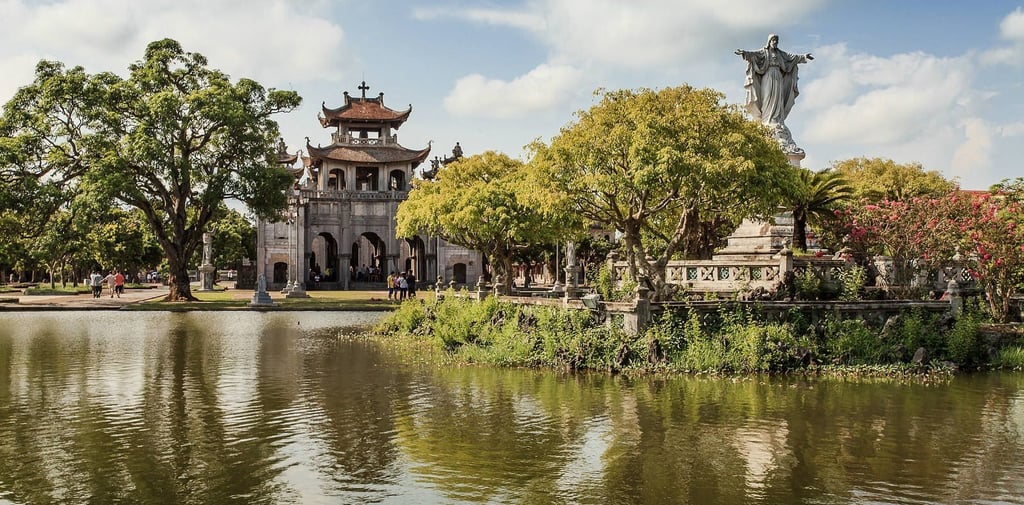
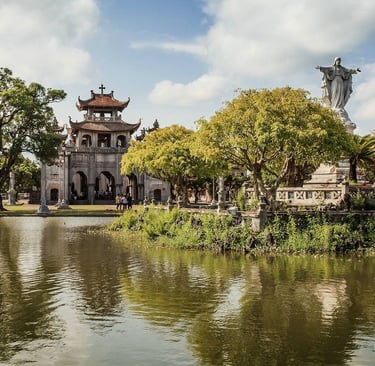
If you travel across Vietnam, you will see hundreds of churches. Most are yellow-walled, Neo-Gothic structures—clones of European cathedrals that feel like foreign transplants in the tropical landscape. But in the coastal district of Kim Son, there is a structure that forces you to stop and question everything you know about religious architecture.
This is the Phat Diem Stone Cathedral.
It is a place where the gargoyles are replaced by stone lions, where the steeples are replaced by curved tiled roofs, and where the cross of Christ rises from a lotus flower. It is, quite simply, the most defiant and brilliant cultural "collision" ever carved into stone. To understand Phat Diem, you don't need a prayer book; you need to understand the mind of the rebel priest who built it: Father Six (Linh mục Phêrô Trần Lục).
I. The Man Who Built a Bridge of Stone
To talk about Phat Diem is to talk about Father Six (1825–1899). He was a man caught between two worlds. He was a Catholic priest in a time when the faith was seen as a "foreign" threat by the Vietnamese monarchy, and he was a Vietnamese patriot in a time when the French were trying to impose their own cultural aesthetic on every brick in the country.
Father Six was not an architect. He was a strategist. He realized that if Catholicism were to survive in Vietnam, it couldn't look like a foreign import. It had to look like it belonged to the ancestors.
Between 1875 and 1898—a staggering 24 years—he led a massive engineering project that seems impossible today. He recruited thousands of people, not just as laborers, but as a community of believers. He sent them into the mountains of Ninh Binh and Thanh Hoa to quarry massive blocks of stone, some weighing up to 20 tons. He didn't have cranes or trucks; he had elephants, wooden rollers, and the rising tides of the river to transport the "bones" of his cathedral.
II. The Architecture of Deception: A Church in Disguise
When you first approach the complex, your eyes will tell you that you are looking at a cluster of Buddhist temples or an imperial palace. This was Father Six's brilliant "deception."
The Phương Đình (Bell House): The entrance to the cathedral is a massive, three-story stone monument called the Phương Đình. It looks exactly like a traditional Vietnamese village gate or a pavilion in a king's palace. It is built entirely of stone—massive slabs that are fitted together with such precision that they have survived earthquakes and wars for over a century.
On the walls, you won't find the typical biblical scenes in the style of the Renaissance. Instead, you see The Four Sacred Animals (Dragon, Unicorn, Tortoise, Phoenix) and The Four Season Plants (Pine, Bamboo, Chrysanthemum, Ochna). For Father Six, the dragon wasn't a monster to be slain; it was a symbol of nobility and protection. He was telling his people: "You don't have to stop being Vietnamese to be Catholic."
The "Oriental Gothic" Roofs: Look at the main cathedral's roof. Instead of a soaring, pointed spire that pierces the sky (the Western style), the roofs of Phat Diem are heavy, tiled, and curved at the corners like the wings of a bird. This is the "Oriental Gothic" style. It doesn't fight the earth; it settles into it. The roof is supported by 52 massive ironwood pillars, each one a single tree trunk dragged from the jungles of the West. It is a forest of wood and stone.
III. The Stone Chapel: A Monolith of Faith
The jewel of the complex is the Chapel of the Immaculate Heart of Mary, known simply as the Stone Chapel.
Everything here is stone. The walls, the pillars, the beams, the altar, and even the "carved wood" panels are actually meticulously carved stone. The craftsmanship is so delicate that when the sun hits the panels, you can see the translucent glow of the rock.
Inside the Stone Chapel, there is a silence that feels different from the brick silence of Chau Son. It is a "cold" silence—the kind that comes from deep within the earth. It took the most skilled artisans of Ninh Van (the village of stone carvers we will visit in Chapter 10) years to turn these gray blocks into delicate lace. They carved the "Tranh Tứ Quý" (Four Seasons) directly into the chapel walls, blending the cycles of nature with the eternal cycle of the liturgy.
IV. The Engineering Miracle of the Swamp
Google will tell you Phat Diem is beautiful. What it won't tell you is that it should have sunk into the mud a long time ago.
The district of Kim Son is reclaimed land—it was a swamp at the edge of the sea. Building a structure with thousands of tons of stone and massive ironwood pillars on soft mud is an engineering nightmare.
Father Six solved this by using a "living foundation." He ordered his workers to bury hundreds of thousands of bamboo stakes into the mud, topped with layers of ironwood planks and boulders. He effectively built a "floating raft" of wood and stone beneath the cathedral. For over 120 years, while modern buildings around it have cracked and tilted, Phat Diem has remained perfectly level. It is a testament to pre-industrial genius that leaves modern engineers scratching their heads.
V. The Political "Third Way"
There is a darker, more complex layer to Phat Diem that most tour guides won't touch. Father Six was a controversial figure. He was accused by some of being too close to the French, and by others of being a secret rebel.
The reality is that Phat Diem was his "Third Way." By building a cathedral that looked like a Vietnamese communal house, he was subtly resisting French cultural dominance. He was saying: "You can occupy our land, but you cannot occupy our aesthetics." Every dragon carved into the stone was a quiet act of rebellion. Phat Diem was a fortress of Vietnamese identity disguised as a house of God.
VI. The Sensory Experience: Moss, Incense, and Ocean Air
Walking through Phat Diem today is a sensory journey. Because it is near the sea, the air carries a faint saltiness. The gray stone has been weathered by a century of storms, turning it into a mosaic of silver and charcoal, often covered in a fine skin of emerald moss.
When the bells in the Phương Đình ring, the sound doesn't just travel through the air; it vibrates through the stone floor beneath your feet. It is a heavy, resonant sound that feels like the heartbeat of the Kim Son coast.
Inside the main cathedral, the smell of aged ironwood mixes with the scent of incense. The light is dim, filtered through high, small windows, creating a chiaroscuro effect that makes the golden altars glow like hidden treasure. It feels ancient, not because of its age, but because of its gravitas.
The Journalist's Epilogue:
Phat Diem is not a church for the faint of heart. It is a massive, heavy, stone declaration of independence. It is a reminder that faith doesn't have to be a colonial import, and that the strongest bridges between cultures are not made of words, but of stone and wood.
Next time you see a yellow Neo-Gothic church in Saigon or Hanoi, think of Father Six. Think of the man who dared to put a dragon on the altar and a lotus beneath the cross. Phat Diem doesn't ask for your belief; it demands your respect for the sheer, stubborn brilliance of the Vietnamese soul.
Next Chapter: If Phat Diem is a story of Stone and Faith, our next chapter takes us to a world of Shadows and Execution. CHAPTER 4: THE ROYAL ABYSS. We are going to Am Tien Cave—the "Tuyet Tinh Coc" of Ninh Binh. We will explore the hidden valley where kings kept tigers to execute prisoners, and why this "romantic" lake has a dark, bloody history.
Are you ready to enter the "Valley of Solitude"?
We are on social media
Vietnam Charm belongs to Vietpearl Travel., JSC
Contact:
Email: info@vietnamcharm.top
© 2026. by Vietnam Charm. All rights reserved
Travel license number: 01-827/2020
Refund Policy