Giảm giá hấp dẫn cho tour du lịch!



THE AQUATIC BAZAAR: FLOATING MARKET CULTURE — DECODING THE HYPER-EFFICIENCY, SOCIAL DEMOCRACY, AND THE RESILIENT SPIRIT OF DELTA COMMERCE
More than trade: exploring the Floating Market as Việt Nam's ultimate fluid commercial and social hub, analyzing its hyper-efficient logistical system, its philosophy of democratic commerce, and its role as the quintessential expression of Southern wit and adaptability.
VIETNAMESE CULTURETHE WATER CIVILIZATIONLOCAL EXPERIENCES
Tobin Nguyen
11/8/20255 phút đọc
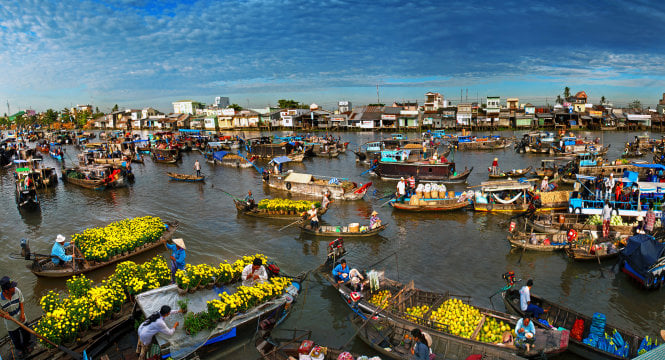
For the ethnographer, the economist, and the seeker of genuine, unvarnished human commerce, the Chợ Nổi (Floating Market)—a dense, vibrant flotilla of boats and barges clustering at the intersection of major waterways—is an unparalleled cultural experience. Found predominantly in the Mekong Delta, markets like Cái Răng (Cần Thơ) or Phụng Hiệp (Hậu Giang) are far more than traditional marketplaces; they are living, self-organizing logistical marvels, the economic heart of the entire water civilization. This unique cultural institution is defined by a philosophy of aquatic democracy, where commerce is conducted with speed, honesty, and a refreshing lack of formal pretense.
As specialists in Vietnamese heritage and profound cultural analysis at Vietnam Charm, we embark on an essential, detailed exploration to decode this vibrant phenomenon. We will meticulously analyze the economic mandate that necessitated its creation, the structural genius of its logistical systems (especially the Cây Bẹo), the sociological intimacy of its daily operation, and the profound way this fluid environment articulates the core Southern values of self-reliance, resourcefulness, and collective efficiency. Understanding the Floating Market is essential to grasping the economic ingenuity and the democratic spirit of the Mekong Delta.
1. The Economic Mandate: Overcoming the Land Barrier Through Water
The existence and enduring success of the Floating Market are a direct, rational, and ingenious response to the logistical challenges presented by the Mekong Delta’s low-lying, fluid geography—a mandate of necessity that dictated water-based, decentralized commerce.
The Delta’s terrain—a vast, intricate network of canals, rivers, and soft, alluvial land—made the construction of dense, fixed road networks and large-scale, central, land-based warehouses economically and structurally prohibitive, especially in the 19th and early 20th centuries. The agricultural economy, however, was highly decentralized, with millions of farmers, fruit orchards, and rice paddies scattered across the vast floodplain. The problem was one of efficient, high-volume aggregation and distribution.
The solution was the Floating Market. By utilizing the kênh rạch (waterways)—which are naturally available, free, and self-maintaining infrastructure—as the primary logistical highway, farmers could move their massive volumes of produce directly from the field to the point of aggregation. The market, therefore, is not a fixed structure but a transient, mobile hub that allows wholesalers (thương lái) to meet producers (nông dân) at a strategic aquatic intersection. This dramatically reduces the need for costly intermediary storage, expensive road transport, and complex land-based infrastructure, making it a masterpiece of hyper-efficient, low-cost logistics dictated by the environment. The market is the physical embodiment of the Delta’s philosophy: work with the water, not against the land.
2. The Structural Genius: Cây Bẹo and the Visual Semaphore System
The logistical efficiency of the Floating Market is crystallized in its most iconic, ingenious structural feature: the Cây Bẹo (Advertising Pole)—a unique, visual semaphore system that allows the market to function without congestion or the need for spoken or written advertisements.
The Cây Bẹo is a tall, slender pole (often bamboo) affixed to the bow or stern of a wholesaler’s boat (ghe). The boat owner attaches a sample of the product they are selling (a pineapple, a stalk of cabbage, a coconut, or a small mound of pomelos) to the very top of this pole. The system functions on three core principles:
Instant Visual Communication: In a dense, often noisy environment spanning a wide river, the Cây Bẹo allows buyers to instantly identify the boat’s inventory from a long distance, eliminating the need to approach every single vessel. This radically increases transactional speed and minimizes aquatic "traffic" jams.
Product Specialization: The market is primarily a wholesale environment. The Cây Bẹo signifies a commitment to volume, meaning the boat is carrying a large, specialized inventory of that specific item (e.g., this is the "pineapple boat"). This allows bulk buyers and large distributors to quickly locate their required commodities.
Honesty and Transparency: The advertised product is physically present for all to see, enforcing a high degree of commercial honesty and immediate accountability.
The Cây Bẹo is thus not merely an advertisement; it is a masterpiece of self-organizing logistical intelligence—a testament to the resourcefulness and pragmatic ingenuity of the Delta merchants.
3. The Sociology of Exchange: Fluid Democracy and Unvarnished Honesty
The Floating Market is a sociological crucible where the intense, day-to-day intimacy of water life meets the high-stakes pressure of commercial negotiation. This environment fosters a unique form of fluid democracy and emotional transparency.
The market operates on a principle of aquatic equality. Wealthy wholesalers, humble farmers, and small-scale retailers all approach the market in the same essential form—the boat—temporarily dissolving the rigid land-based social hierarchies. The negotiation is direct, often loud, and highly personalized, built on face-to-face trust (quan hệ) established over years of repeated interaction. Unlike formal retail, the commerce is unvarnished; buyers inspect the produce directly, and prices are negotiated based on immediate, mutual agreement.
The market also functions as the primary social and news hub for the riverine communities. Merchants, after concluding the bulk of their trade, often spend the rest of the morning exchanging gossip, sharing information about weather, crop yields, and river currents, and participating in the unique culture of "chợ trên bờ" (market on the riverbank). This secondary social function ensures that the market is not just a place of trade but a powerful mechanism for community cohesion and informational exchange, binding the decentralized population of the Delta together.
4. The Culture of Self-Sufficiency: Multi-functional Living and Unseen Resilience
The life on the Floating Market demands a profound level of self-sufficiency and multi-functional living—a lifestyle that is the very epitome of the Delta’s resilience.
The boat (ghe) is not simply a vehicle of commerce; it is the multi-functional core of existence. It serves simultaneously as the family home, the product warehouse, the retail space, and the primary means of transport. Families live, cook, sleep, and raise children entirely on board their vessel, often for generations, creating a specialized, inherited culture of water mastery. This requires extreme organizational discipline and resourcefulness, as every square meter of the limited space must serve multiple purposes.
This self-contained, fluid existence instills a deep sense of pragmatism and environmental literacy. The merchants are intimately attuned to the subtle shifts in the river's current, the weather patterns, and the seasonal changes in the market's inventory—a knowledge that is crucial for both survival and economic success. The vibrant, often brightly painted boats, adorned with the iconic "mắt ghe" (boat eyes) painted on the bow to ward off danger and see through the fog, are a visible expression of this cultural commitment—a blend of practical necessity and deep-seated spiritual belief in the protection of the water spirits.
5. Conclusion: The Permanent Testament to Aquatic Ingenuity
The Floating Market is the ultimate, enduring testament to the ingenuity, adaptability, and democratic spirit of the Mekong Delta. It is a fluid institution that transforms the logistical challenge of a water-bound environment into a system of unparalleled commercial efficiency and social cohesion. By analyzing the economic mandate that necessitated its creation, the structural genius of the Cây Bẹo semaphore, the sociology of its honest, fluid exchange, and the self-sufficient discipline of its water-based life, the observer gains access to a core truth: the Floating Market is far more than a place of trade. It is the permanent, unwavering tone of aquatic ingenuity—a powerful, living declaration that asserts the cultural value of pragmatic efficiency, democratic commerce, and the belief that the strongest, most resilient communities are those that structure their lives around the natural flow of the environment, not in opposition to it.
We are on social media
Vietnam Charm belongs to Vietpearl Travel., JSC
Contact:
Email: info@vietnamcharm.top
© 2026. by Vietnam Charm. All rights reserved
Travel license number: 01-827/2020
Refund Policy