Giảm giá hấp dẫn cho tour du lịch!



THE BRICK PHANTOM OF CHAU SON
A tale of two silences: One is the heavy, sacred quiet of a 1939 brick fortress, the other is the forgotten whisper of monks living in 'White Martyrdom.' Learn how to bypass the noisy tour buses of Tam Coc to find a Gothic masterpiece held together by molasses and absolute devotion
NINH BINHLOCAL EXPERIENCES
Tobin Nguyen
1/23/20265 phút đọc
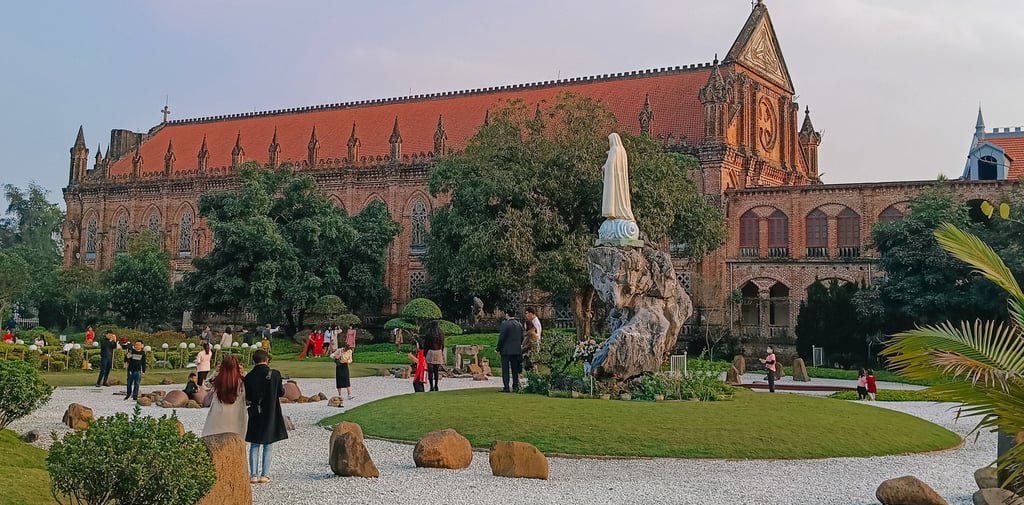
A Requiem of Molasses, Clay, and the Art of Disappearing
If you are looking for a breezy afternoon with a pretty backdrop for your Instagram feed, stay in Tam Coc. Drink your latte, take your boat ride through the caves, and head home with a superficial sense of satisfaction. But if you are the kind of soul who wonders what happens when human obsession meets a silence so heavy it feels like a physical weight, then follow me.
We are heading toward the Nho Quan district, to a place that technically shouldn't exist. It is a red phantom lurking in a limestone valley. They call it the Chau Son Monastery. But to those who know the truth, it is a 1939 miracle held together by molasses, grit, and a brand of "madness" that only the truly devout can possess.
I. The Architect of Shadows: Construction Without a Voice
Let’s talk about 1939. The world was screaming in the throes of war. Amidst this chaos, a man named Father Placide Truong Minh Trach—a monk who likely spoke to God more than to men—decided to build a fortress.
He wasn't a celebrity architect from Paris. He was a self-taught monk with a vision of a Gothic cathedral that belonged in a French forest but was destined to rise from the tropical mud of Vietnam. With no professional blueprints, he navigated by heart, using old books as his only guide. He signaled with his hands to local farmers on where to lay each brick.
The Alchemy of the Wall: They didn't use modern cement. Instead, they used a pre-industrial alchemy: a dark, sticky concoction of molasses (mật mía), lime, and local resins. Every brick was fired from the very earth they stood upon. The monks were forbidden from speaking while they worked; they believed words were a distraction from the "prayer of the hands."
If a section of the wall was even a millimeter off-kilter, Father Placide would simply point, and the monks would dismantle it in total silence, starting over until the brick was "honest." The building didn't just rise; it was prayed into existence. When you run your hand along those bricks today, you aren't feeling cold ceramic; you are feeling the organic "glue" of human patience.
II. 3:15 AM: The "White Martyrdom"
You might see them in the afternoon—shadowy figures in white robes sweeping leaves. It looks peaceful, doesn't it? Do not let your eyes deceive you. Their life is a grueling "White Martyrdom" (Tử đạo trắng).
In their tradition, they do not seek the glory of a quick, bloody death for their faith (the "Red Martyrdom"). Instead, they choose the slow, daily death of the ego. At exactly 3:15 AM, while the Ninh Binh mist is still swallowing the limestone peaks, a bell tolls. This is when the monks wake.
The Routine of Steel: They spend eight hours a day in prayer and eight hours in back-breaking labor. They have no heaters in the 10°C winters, and no air conditioning in the suffocating July heat. They farm the fields, fire the bricks, craft furniture, and brew wine. They eat in deafening silence. If they need salt, they use a hand signal. They believe that words are an expensive luxury, and they save them only to whisper to the Infinite.
Behind the public courtyard lies the "Clausura" (The Enclosure). Behind this door, monks live in "cells"—tiny brick boxes with a wooden bed, a desk, and a crucifix. No mirrors are allowed. In their tradition, looking at your own reflection is the ultimate vanity. You spend your life looking only at the work of your hands and the silence of the valley.
III. Intellectual Ghosts: The Men Behind the Robes
The great paradox of Chau Son is this: behind those weathered white robes often lie brilliant minds. Among them are former doctors, engineers, and professors.
I once encountered an elderly monk whose hands were calloused like tree bark from years of tilling the soil. Yet, when he spoke—in a rare, permitted exchange—he discussed Heidegger’s philosophy and the nuances of Romanesque architecture in a flawless, archaic French. They are "Intellectual Ghosts" who have hidden themselves to seek a truth they believe cannot be found in the noise of the city. They didn't come here because they were "lost"; they came here because they found something the rest of us are too loud to hear.
IV. The 1950s: The Shadow Play of Survival
After 1954, the monastery faced a harsh historical reality. In the shifting political landscape of North Vietnam, religious sites were often viewed with deep suspicion. Chau Son survived through a brilliant, desperate piece of theater.
The monks turned the monastery into a "Model Farm." By day, they were elite socialist laborers, growing rice and making bricks better than anyone else to prove their value to the state. By night, they retreated behind the red bricks to keep Gregorian chants alive in whispers. Every brick you see today is a veteran of that era—a survivor that learned to hide its soul in the soil just to keep its doors open.
V. The Final Breath: The Cemetery of No Names
This is the part that should make you shiver. At Chau Son, death comes without fanfare.
When a monk passes away, his body is placed in a simple wooden casket crafted by his brothers in the monastery’s own workshop. He is carried to a private cemetery hidden behind the mountains, far from the eyes of tourists. There are no grand monuments here. No marble statues. Only flat mounds of earth with small crosses marking a religious name and a date.
The Philosophy of Vanishing: Their goal is to "Vanish." After a few years, the mound of earth flattens, merging back into the grass and trees. They live in silence and die without leaving a trace of the "self." These departed monks lie there, becoming the very nutrients of the valley, so that the next generation can wake up at 3:15 AM and continue praying for a world that has forgotten how to be quiet.
VI. The Garden of Rejection
Wander behind the main cathedral, and you’ll find a rock garden that feels... jagged. It’s not the manicured Zen gardens of Japan. The monks call it their "Garden of Rejection." For years, they went to the nearby limestone quarries and collected the "trash"—the irregular blocks and scraps that construction companies threw away as useless. They brought these "scraps" back and arranged them into a meditative landscape. The message is silent but devastating: Nothing is "waste" in the eyes of the Creator. If you can take the stones the world rejected and make them into a masterpiece, then there is hope for even the most broken human soul.
The Insider's Epilogue: When you stand in the courtyard of Chau Son, do not look for a "tourist attraction." Look for a Silent Resistance. Look at the patina on the bricks—how the humidity has turned some black and others a vibrant, mossy green. The monks never clean them. They want the building to age, to scar, and to weather just like a human being.
You didn't come here to see a beautiful building. You came to witness a miracle made of mud, molasses, and the sheer willpower of men who chose to disappear.
We are on social media
Vietnam Charm belongs to Vietpearl Travel., JSC
Contact:
Email: info@vietnamcharm.top
© 2026. by Vietnam Charm. All rights reserved
Travel license number: 01-827/2020
Refund Policy