Giảm giá hấp dẫn cho tour du lịch!


THE COSMIC RESET: TẾT NGUYÊN ĐÁN — DECODING THE SACRED RITUAL OF TIME, ANCESTORS, AND THE VIETNAMESE SOUL
More than a celebration: exploring the profound philosophical, social, and spiritual function of Tết as the mandatory national reset—a moment for communion with the ancestral world, purification of debt, and the supreme affirmation of collective identity and hope.
HERITAGE & SPIRITLOCAL EXPERIENCES
Tobin Nguyen
11/6/20257 phút đọc
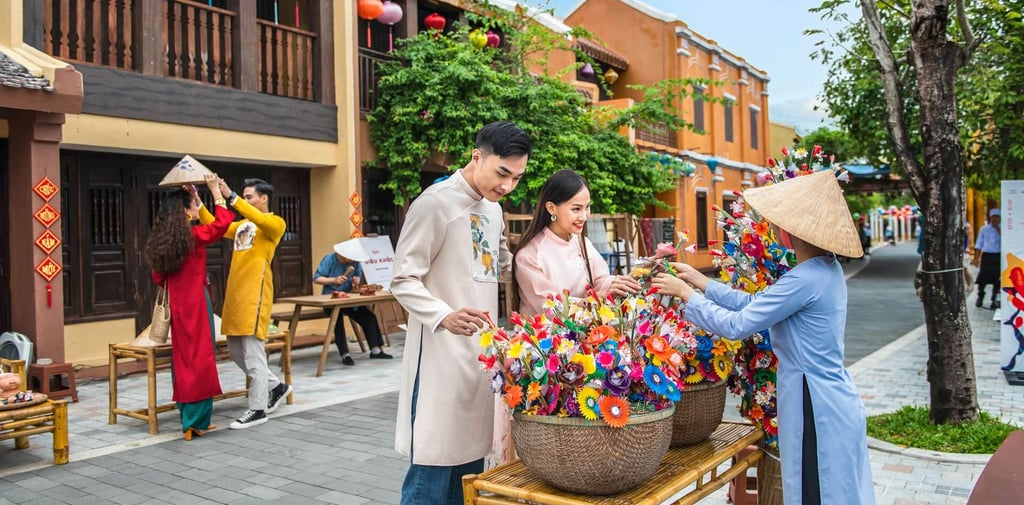
For the international observer, the Tết Nguyên Đán (Vietnamese Lunar New Year) is a spectacular outburst of color, sound, and festivity. It is a period defined by the fiery red of the lucky money envelopes (Lì Xì), the golden glow of the apricot blossoms (hoa mai), and the cacophony of firecrackers and drumming. Yet, to view Tết merely as a holiday is to fundamentally misunderstand its profound, indispensable role in the Vietnamese consciousness. Tết is not an event; it is a mandatory national pilgrimage of the spirit—the single, most important annual ritual that completely arrests the flow of time, demanding a thorough, uncompromising reset of the cosmos, the community, and the self. It is the spiritual anchor that holds the nation together, regardless of political shifts or geographical dispersion.
As specialists in Vietnamese heritage and profound cultural analysis at Vietnam Charm, we embark on an essential, detailed exploration to decode this supreme cultural festival. We will meticulously analyze the philosophical concept of time that underpins the celebration, the sacred protocols governing the crucial ancestral communion, the culinary symbolism embedded in the mandatory foods, and the immense social and emotional gravity of the Đoàn Viên (Family Reunion). Understanding Tết is essential to grasping the cyclical nature of Vietnamese morality, the absolute priority of the family unit, and the deep, abiding faith in the power of hope and sincere intention to shape destiny.
1. The Philosophical Architecture: The Mandatory Cosmic Reset
Tết is a celebration whose spiritual weight lies entirely in its role as a cosmic and moral reset mechanism. The transition from the old year (Năm Cũ) to the new (Năm Mới) is viewed as a moment of profound vulnerability, opportunity, and absolute cleansing, requiring meticulous, pre-emptive action.
The period preceding the main holiday is dedicated to the comprehensive purification of the old. This purification is multifaceted: physical, financial, and spiritual. Every home must be thoroughly cleaned from ceiling to floor (tổng vệ sinh), symbolizing the sweeping away of bad luck, stagnation, and lingering misfortune from the past year. Crucially, all debts—financial and social—must be settled before the new year officially begins. To carry a debt into the new year is to invite perpetual hardship. This mandatory debt-clearing is a powerful philosophical statement: the community and the individual must begin the new cycle with a clean, unburdened slate, ensuring that destiny is not constrained by the failures of the past.
The pinnacle of this transition occurs on the 23rd day of the 12th Lunar month with the ceremony of the Ông Táo (Kitchen Gods). The Kitchen Gods—a trio of deities who oversee the household's affairs—ascend to the Jade Emperor in heaven to report on the family’s conduct over the past year. Their departure marks the symbolic end of the old cycle and the beginning of the spiritual interregnum. The offerings, including the live carp (which symbolically transports the Gods to heaven), are a powerful, sincere plea for a favorable report, affirming the family’s moral integrity and hope for celestial blessing in the coming cycle. This ritual transforms the kitchen—the physical heart of the Vietnamese home—into the sacred communications hub between the mortal and spiritual worlds.
2. The Ancestral Communion: Đoàn Viên and the Return of the Spirit
The supreme, non-negotiable function of Tết is the communion with the ancestors (Tổ Tiên). The family reunion (Đoàn Viên) is not merely a social gathering; it is a spiritual imperative, an act of anchoring the family tree in time.
The most intense movement during Tết is the mass migration back to the ancestral home. Regardless of how far children or relatives have traveled for work or education, the commitment to return to the village or the primary family house is absolute. This physical return symbolizes the continuity of the bloodline and the reaffirmation that the family, both living and dead, remains the central, defining unit of existence.
The Ancestral Altar (Bàn Thờ) takes center stage during Tết. It is meticulously cleaned and elaborately decorated with the finest offerings: the Mâm Ngũ Quả (Five-Fruit Tray), the Bánh Chưng (Square Rice Cake), fresh flowers, and the strongest calligraphy wishes (Thư Pháp). This altar is the temporary dwelling place of the ancestors, whose spirits are believed to return to the home to celebrate with their living descendants. The ritual performance of Lễ Cúng (Offerings), where the living formally invite the spirits to partake in the feast and present their hopes and reports for the new year, is a solemn, deeply moving exchange. This communion ensures that the ancestors remain active, present members of the family council, offering their spiritual protection and wisdom for the cycle ahead. The silence and incense-filled air around the altar during the New Year's Eve transition are moments of profound spiritual gravity.
3. The Culinary Symbolism: Earth, Heaven, and the Mâm Ngũ Quả
The food consumed during Tết is not mere sustenance; it is a deep, intricate language of symbolism, with every dish acting as a coded message of fortune, cosmological balance, and ancestral reverence.
The cornerstone of the Tết feast is the pair of sacred cakes: Bánh Chưng and Bánh Dày. This duality represents the core cosmology of the rice civilization:
Bánh Chưng (The Square Cake): Made from sticky rice, mung beans, and pork, tightly compressed and wrapped in square layers of green lá dong (phrynium leaves). It symbolizes Đất (Earth), the feminine principle (Yin), and the source of material sustenance. The square shape represents the stability and fertility of the land.
Bánh Dày (The Round Cake): A simple, round, white mound of pure steamed sticky rice. It symbolizes Trời (Heaven), the masculine principle (Yang), and the celestial blessings of rain and sun. The pairing of Bánh Chưng and Bánh Dày is an annual reaffirmation of the cosmic balance necessary for life, symbolizing the perfect harmony of Heaven and Earth.
Equally critical is the Mâm Ngũ Quả (Five-Fruit Tray) placed on the altar. The selection of five fruits symbolizes the Five Elements (Ngũ Hành) and is chosen based on a linguistic pun that forms a wish. In Southern Việt Nam, the popular selection might include: Mãng cầu (soursop), Dừa (coconut), Đu đủ (papaya), Xoài (mango), which sound like “Cầu Vừa Đủ Xài” (A Wish for Just Enough to Spend), reflecting a desire for sufficiency and modest abundance rather than excessive wealth. The tray is thus a silent, sincere prayer offered through color and language to the ancestors.
4. Social Protocols and Fortune: The Art of Starting Well
Tết is governed by strict, unwritten social protocols that mandate actions and words intended to secure good fortune (Lộc) for the entire year. The overriding philosophy is that the way the year starts will dictate the way the year unfolds.
The most critical post-midnight ritual is Xông Đất (First Footing). The very first person to enter the home in the New Year is believed to determine the family's luck for the entire year. Therefore, a person whose age, zodiac sign, personality, and success are deemed favorable—a man of high standing, good health, and documented success—is often pre-selected or invited to perform the Xông Đất ritual. This is a profound statement on the belief in sympathetic magic, where the quality of the ritual actor transfers to the recipient.
The ritual of Lì Xì (Lucky Money) is equally vital. Elders give new, crisp banknotes in red envelopes to children and unmarried adults. This is not charity; it is a transmission of good fortune. The red envelope symbolizes fire and vitality, and the money inside is a wish for the recipient’s prosperity, health, and academic success. Children receiving the Lì Xì must offer a sincere, respectful New Year's greeting before accepting the envelope, affirming the social hierarchy and the value of respect. Conversely, all conversations during Tết must be strictly positive, hopeful, and forward-looking. Negative words, arguments, criticism, or dwelling on past misfortunes are strictly forbidden, as they are believed to manifest those unwanted energies into the new cycle.
5. The Enduring Resilience: Tết in the Modern Diaspora
The profound importance of Tết has not diminished in the face of economic modernization or the vast global Vietnamese diaspora. If anything, the distance and the pressure of modernity have only intensified the commitment to the ancient rituals.
For Vietnamese communities scattered across North America, Europe, and Australia, Tết becomes an even more powerful, emotional act of cultural sovereignty and resistance. Despite the challenges of securing traditional foods, aligning time zones, and observing rituals far from the ancestral burial sites, the Diaspora meticulously recreates the atmosphere. The act of making Bánh Chưng outside of the tropical homeland, sourcing the correct peach or apricot blossoms, and organizing communal celebrations becomes a vital, active process of preserving cultural memory and transmitting identity to the younger generations who have never seen the ancestral village.
Tết, in its modern iteration, stands as the ultimate, living proof of the Vietnamese spirit’s unwavering resilience. It ensures that even as the world speeds up and the distance from the homeland grows, the spiritual and moral compass—centered on family, ancestor respect, and the hope for a morally pure future—remains firmly intact. The four or five days of the holiday act as a powerful, collective therapy, stabilizing the nation and the self for the challenges of the cycle ahead.
Tết Nguyên Đán is the ultimate, masterful achievement of Vietnamese cultural life. It is not merely a break from work; it is a comprehensive, necessary pause of the entire world, a sacred ritual that cleanses the past and ritualistically structures the future. By analyzing its philosophy of debt-clearing, its mandatory ancestral communion, its profound culinary codes, and its strict social protocols, the observer gains access to the very heart of the Vietnamese soul: a spirit defined by profound respect for tradition, an absolute dedication to the family, and an eternal, active commitment to shaping destiny through hope and sincere intention.
We are on social media
Vietnam Charm belongs to Vietpearl Travel., JSC
Contact:
Email: info@vietnamcharm.top
© 2026. by Vietnam Charm. All rights reserved
Travel license number: 01-827/2020
Refund Policy