Giảm giá hấp dẫn cho tour du lịch!


THE ELEVATED LIFE: NHÀ SÀN — DECODING THE STILT HOUSE AS THE ULTIMATE ARCHITECTURE OF ENVIRONMENTAL AND SOCIAL HARMONY
More than protection: exploring the profound spatial philosophy of the Nhà Sàn (Stilt House), analyzing its role as a perfect, resilient response to the tropical environment, and its deep structural articulation of ethnic minority cosmology, social hierarchy, and collective memory.
LOCAL EXPERIENCESVIETNAMESE CULTURETHE ARCHITECTURAL SOUL
Tobin Nguyen
11/6/20256 phút đọc
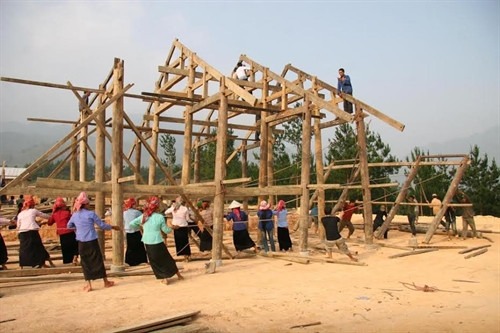
For the cultural anthropologist, the Nhà Sàn (Stilt House), prevalent among Việt Nam's ethnic minority communities (such as the Thái, Tày, Bana, and the famed Ê-đê longhouse cultures), is the single most compelling and structurally honest form of vernacular architecture. It is not a structure of permanence built from stone, but a living, breathing, organic architecture constructed from the renewable resources of the forest—bamboo, wood, and thatch. The Nhà Sàn is far more than a practical shelter raised off the ground; it is a perfect, millennia-old engineering solution to the tropical challenges of flood, humidity, and animal danger, and, critically, a three-dimensional diagram of the community's spiritual cosmology and social structure. The entire philosophy of life in harmony with the mountain and the jungle is codified in its elevated frame.
As specialists in Vietnamese heritage and profound cultural analysis at Vietnam Charm, we embark on an essential, detailed exploration to decode this philosophy of elevation. We will meticulously analyze the environmental imperative that dictates the house's raised floor, the spiritual geometry that divides its space into realms of Earth, Man, and Sky, the sociological function of its structural variations (particularly the matrilineal longhouse), and the profound way this sustainable architecture articulates the ethnic groups' commitment to collective memory, environmental respect, and deep social discipline. Understanding the Nhà Sàn is essential to grasping the core values of harmony, resilience, and the enduring connection between the people and the forest.
1. The Environmental Imperative: Climate Control and the Wisdom of Elevation
The fundamental defining feature of the Nhà Sàn—its elevation—is an ingenious, practical, and highly sophisticated response to the specific environmental challenges of the mountainous and heavily forested regions of Việt Nam. This is architecture as applied, practical science.
The primary function of raising the house floor (the Sàn) 1.5 to 3 meters above the ground is climate control and pest protection. The elevation acts as a crucial barrier against the relentless tropical humidity and monsoonal flooding that characterize the region. By allowing air to circulate freely beneath the house (Gầm Nhà), the elevated floor acts as a massive cooling convection system, drawing heat away from the living space above and preventing the absorption of moisture that would otherwise rot the structure and invite mold. This continuous air flow is the key to maintaining a dry, relatively cool internal environment, essential for health and comfort.
Furthermore, the elevated structure provides immediate, practical protection from the dangers of the forest. It is an effective defense against wild animals, snakes, insects, and predatory pests, separating the human domain from the chaotic, non-human realm of the ground. The elevation also creates a highly functional, covered, and dry workspace (Gầm Nhà) which is neither fully inside nor fully outside. This space is used for storing tools, processing agricultural products (drying rice or processing cassava), and, most importantly, for sheltering livestock and large domestic animals (buffalo, pigs). The architecture thus integrates the entire economy of the household—human, agricultural, and animal—into one unified, multi-functional structure.
2. The Vertical Cosmology: The Tripartite Division of Existence
The Nhà Sàn is structured according to a deep vertical cosmology that meticulously divides the entire space into three distinct, spiritually and functionally defined realms, reflecting the society's view of the universe. This division codifies the relationship between the mundane, the human, and the sacred.
Realm I: The Ground (Gầm Nhà - The Space Below): This is the domain of Earth and the Mundane. As noted, it is the practical space for animals, waste, storage, and the processing of raw materials. It is the realm of the non-human and the realm of labor that interacts directly with the soil. It is defined by its impermanence and its proximity to the chaos of nature. It is Yin—dark, cool, and foundational.
Realm II: The Floor (Sàn Nhà - The Living Space): This is the domain of Man and Community. It is the sacred human space, the location of the hearth (bếp), the sleeping areas, the family meals, and the receiving of guests. This is the Yang realm—light, active, and defined by social hierarchy and strict moral conduct. All important human rituals, from birth to courtship, occur on this elevated plane, physically separating the human society from the base nature of the forest floor.
Realm III: The Roof (Mái Nhà - The Space Above): This is the domain of Sky and the Sacred. The roof and the space immediately beneath it are symbolically reserved for the Ancestors and the Spirits. Certain essential, sacred household items—such as the family's spiritual offering basket, instruments for rituals, or the large rice storage basket—are often stored high, near the roof line, physically placing them under the protection of the ancestors and closer to the heavens.
This tripartite vertical division is an absolute, non-negotiable rule of construction, ensuring that the physical house perfectly mirrors and reinforces the community's spiritual universe.
3. The Structural Heart: Cột Cái and the Spiritual Axis
The structural integrity and, more critically, the spiritual integrity of the Nhà Sàn rests entirely upon its Cột Cái (Main Pillar). This central column is far more than a load-bearing element; it is the spiritual axis (axis mundi) of the home and the physical connection between the family and the cosmos.
The selection, preparation, and erection of the Cột Cái are performed under the most solemn, complex ritual conditions. It must be carved from a single, massive, perfectly straight tree, often chosen from a sacred section of the forest. The placement of the pillar is dictated by auspicious timing (ngày tốt) and strict adherence to the family head's spiritual chart. Once placed, the Cột Cái is believed to be the dwelling place of the house spirit (Thần Nhà) and the direct conduit for ancestral spirits to observe and protect the family.
In many groups, the Cột Cái is ritually adorned and treated with the highest respect; it may never be tied to, leaned against casually, or touched by an unworthy person. Any damage to this pillar is not just structural; it is seen as a profound spiritual catastrophe that threatens the health, luck, and prosperity of the entire family. The physical strength of the house is entirely dependent on this pillar, just as the spiritual strength of the family is dependent on its connection to the Sky and the Ancestors.
4. The Architecture of Kinship: The Longhouse and Social Fluidity
The variation of the Nhà Sàn known as the Nhà Dài (Longhouse)—the signature architecture of the matrilineal Ê-đê and other groups in the Central Highlands—is the ultimate, spectacular example of architecture as a physical chronicle of family growth and social hierarchy.
The Longhouse is literally a living, growing ledger of the matrilineal family's history. The house is built to accommodate the entire extended clan, following the rule that when a daughter marries, a new section (a gian) is added to the length of the existing structure, reinforcing the social priority of the female line. A house can sometimes reach over 100 meters in length, physically displaying the generational prosperity and social depth of the lineage. This structural adaptation beautifully mirrors the matrilocal custom, where the husband moves into the wife's home. The house thus grows horizontally over time, constantly reflecting the current size and status of the mother's clan.
Internally, the Nhà Dài maintains a strict social geometry:
The Entrance/Guest Area (Phòng Khách): This is the larger, public section, often containing the massive, ceremonial Gong Set (Cồng Chiêng). This is the domain of the men, the location for community meetings, and the receiving of external guests.
The Living Quarters (Phòng Ngủ): The private, rear section is partitioned into smaller, individual sleeping bays for the couples and the children of the lineage. This is the domain of the women, the location of the hearths, and the core of the family's intimate life.
The Longhouse is, therefore, a social machine—a structure that constantly enforces the rules of gender, kinship, and ceremony through the physical arrangement of wood and bamboo.
5. Conclusion: The Enduring Harmony of the Forest
The Nhà Sàn is the most profound architectural testimony to the Vietnamese ethnic groups' wisdom, resilience, and unwavering commitment to environmental harmony. It is an architecture of necessity transformed into an art of living. By analyzing the simple, ingenious elevation that solves complex tropical problems, the tripartite cosmology that divides the human world from the spirit and animal realms, the sanctity of the Cột Cái as the spiritual axis, and the structural poetry of the matrilineal Longhouse, the observer gains access to a core truth: the Nhà Sàn is not just a building; it is a highly evolved organism that perfectly shelters its inhabitants while protecting their history and their belief system. It is the ultimate, elegant declaration of a people who choose to live with the forest, not against it, proving that the highest form of architecture is the one that achieves the deepest, most respectful integration with its natural world.
We are on social media
Vietnam Charm belongs to Vietpearl Travel., JSC
Contact:
Email: info@vietnamcharm.top
© 2026. by Vietnam Charm. All rights reserved
Travel license number: 01-827/2020
Refund Policy