Giảm giá hấp dẫn cho tour du lịch!


The Emperor’s Palate: Decoding Royal Cuisine — A Look at the Rituals, Aesthetics, and Miniature Masterpieces of Hue’s Imperial Kitchen
The taste of history and refinement: exploring the subtle elegance, rigorous presentation, and profound philosophical difference between the exclusive cuisine of the Nguyễn dynasty and the hearty folk dishes of Huế.
LOCAL EXPERIENCESFOODS
Tobin Nguyen
11/7/20256 phút đọc
For the discerning global palate, the initial encounter with Vietnamese food is often the vibrant, immediate chaos of street stalls and the robust simplicity of Phở. However, the true journey into the nation’s deepest culinary soul—into its history, its highest aesthetic values, and its political philosophy—leads inevitably and ceremoniously to Huế. Huế, the former Imperial Capital of the Nguyễn Dynasty (1802–1945), offers a unique and profound culinary dichotomy: the austere, flavorful folk cuisine (ẩm thực dân gian) and the ethereal, rigorously sophisticated Royal Cuisine (ẩm thực cung đình). This is where food transcends mere sustenance to become high art, political ritual, and a deliberate expression of spiritual and cosmic philosophy.
As specialists in Vietnamese heritage, historical deep dives, and sophisticated gastronomy at Vietnam Charm, we embark on an essential, detailed analysis to decode this Imperial Palate. We will meticulously examine the historical context, the aesthetic rigor, the miniature masterpieces of presentation, and the fundamental philosophical differences between the food cooked for the common people and the meals served to the Emperor. Understanding Royal Cuisine is not just an exercise in taste; it is essential to grasping the level of refinement, discipline, and historical consciousness that defines Central Vietnamese culture and its enduring influence on contemporary dining.
I. The Historical Context: Food as a Political and Spiritual Act
Royal Cuisine was never merely about satisfying hunger or simple flavor; it was a complex system of governance, hierarchy, and ritual. Under the Nguyễn Dynasty, every single aspect of the Emperor’s meal—from the source of the ingredients and the precise cooking method to the presentation, the number of dishes, and the sequence of service—was strictly regulated by rigid court protocols. Food, in the Imperial Citadel, was seen as a reflection of the cosmic order and the Emperor’s central position between Heaven and Earth.
The Rigor of the Imperial Kitchen
The preparation of the Emperor’s meal was an immense undertaking, entrusted only to specialized teams of hundreds of highly skilled court cooks (thượng thiện) and dedicated, trusted court officials. The key, non-negotiable principles guiding the Imperial Kitchen were layered with meaning:
Safety and Purity (An Toàn và Thanh Tịnh): Given the immense political stakes, absolute safety was paramount. Every dish, before reaching the Emperor’s table, was meticulously tasted and sampled by court officials, often trusted eunuchs, in a strict ritual to guard against poisoning. Ingredients themselves were sourced exclusively from specific, trusted regions known for their quality, requiring them to be unique regional delicacies (sơn hào hải vị), never common fare.
Medicinal and Cosmic Balance (Âm-Dương và Ngũ Hành): Meals had to be rigorously balanced according to the complex principles of Yin-Yang (Âm-Dương) and the Five Elements (Ngũ Hành). Dishes were never chosen randomly; they were deliberately selected to harmonize with the immediate weather, the changing seasons, and the Emperor’s current physical and spiritual well-being. This was food as sophisticated preventative medicine, ensuring the ruler's longevity, physical strength, and political stability, reflecting cosmic harmony.
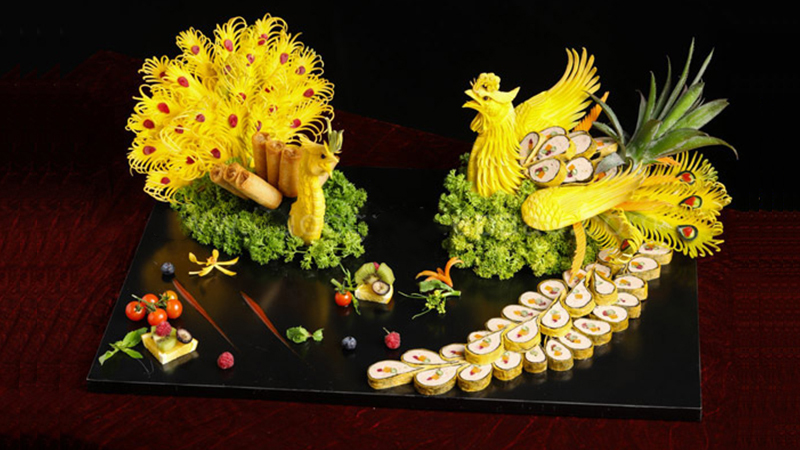
Aesthetics and Miniaturization (Mỹ Thuật và Thu Nhỏ): Above all, the food was required to be a visual feast. Presentation was paramount, often elevating the dishes to miniature masterpieces. Ingredients were meticulously carved into decorative, symbolic shapes (e.g., flowers, mythical creatures like dragons or phoenixes) and arranged in complex, multi-tiered stacks. The smaller the portion, the more intricate the carving, the higher the perceived value and refinement of the cooking skill.
II. The Aesthetics and Rituals: Food as High Art and Performance
The presentation of Royal Cuisine was perhaps its most powerful distinguishing feature. It was explicitly designed to appeal to all five senses, with a deliberate, overwhelming emphasis on visual elegance and symbolism that reflected the profound solemnity and hierarchy of the court.
The Art of the Miniature Masterpiece
Unlike the generous, large, overflowing servings characteristic of folk cuisine, Royal Cuisine focused intensely on miniaturization and detail. Meals for the Emperor were incredibly elaborate, often comprising between 50 to 100 small, distinct dishes, with only tiny, highly concentrated portions of each presented.
Color and Number: Dishes were rigidly mandated to feature the five cardinal colors (corresponding to the Five Elements: white, green, yellow, red, black) to ensure balance and visual harmony on the table. Furthermore, the number of dishes often followed auspicious numbers (e.g., 7, 9, 12, 50, or 100), connecting the meal directly to spiritual numerology.
The Container: Food was served exclusively in exquisite, often custom-made porcelain bowls and plates, frequently adorned with imperial symbols like the dragon (for the Emperor) and the phoenix (for the Empress). The vessel itself was considered an extension of the food's value, regarded as artistically and materially as important as the content itself.
The Ritual of Serving: The entire serving ritual was a highly synchronized choreography. Dishes were brought into the dining hall in a silent procession, meticulously placed on the Emperor's table following strict, pre-determined patterns, and removed swiftly and silently upon his signal. The Emperor often ate alone, or with the Empress only on special occasions, turning the meal into a highly ritualized, somewhat isolated performance of absolute sovereignty.
III. The Fundamental Dichotomy: Royal Cuisine vs. Folk Cuisine
The profound contrast between the food consumed within the Citadel walls and the food consumed on the streets of Huế highlights the fundamental class and cultural separation of the era. The two cuisines existed in a parallel universe, influencing each other only subtly.
The Taste of Austerity vs. Generosity
Goal and Function: The goal of Royal Cuisine was Ritual, Balance, Aesthetics, and Longevity. The goal of Folk Cuisine was Sustenance, Immediate Flavor, Community, and Affordability. Royal meals were a performance; Folk meals were life.
Flavor Profile: Royal Cuisine favored flavors that were subtle, nuanced, and gentle—a barely perceptible sweetness or saltiness, reflecting the Imperial palate's refinement and avoidance of aggressive flavors. Folk Cuisine was robust, often spicy, immediate, and complex in its layering (e.g., strong fermentation, heavy fish sauce, aggressive chili). Folk food needed to be hearty, stimulating, and satisfying immediately.
The Case of Bún Bò Huế: The most famous example of this divergence is Bún Bò Huế. The dish we know today—a robust, spicy, lemongrass-infused, aggressively flavored noodle soup (a quintessential Folk dish)—is far removed from its subtle origins. While the Imperial Kitchen likely served a clean, much subtler, less intense version of a beef noodle soup, adapted to the delicate, nuanced palate of the court, the street cuisine took the affordable ingredients (beef knuckles, pork hock, fermented shrimp paste) and intensified them, maximizing flavor and heat to satisfy the common worker's need for a cheap, filling, and stimulating meal.
Folk cuisine represents the common people’s ingenuity in maximizing flavor with affordable, local resources, while Royal Cuisine represents the elite's pursuit of perfection and aesthetic control.
IV. The Living Legacy: Bánh Huế and Modern Adaptation
The most enduring, accessible legacy of Royal Cuisine today is found in the refined tradition of Bánh Huế (Huế Rice Cakes). These are small, delicate steamed or savory cakes that required immense precision and skill to produce—a technique honed during the Imperial era where consistency was mandatory.
Bánh Bèo: Delicate, saucer-shaped rice cakes, perfectly steamed and topped sparingly with dried shrimp powder and scallion oil. They are eaten individually with a special, slightly diluted fish sauce.
Bánh Nậm: Flat, rectangular rice cakes steamed inside banana leaves, maintaining moisture and delicate shape.
Bánh Khoái: The Central Vietnamese sizzling pancake, distinguished from its Southern counterpart by its smaller, denser size and its absolute reliance on a thick, rich, savory peanut-based dipping sauce (nước lèo).
These dishes represent the democratization of refinement. The techniques—the focus on small, individual servings (portion control) and the emphasis on the complex dipping sauce—are direct inheritances of the court's aesthetic and discipline principles, now enjoyed by everyone on a low plastic stool. The very act of eating these small, distinct portions forces the diner to slow down, echoing the measured, contemplative pace of the former Imperial Court.
V. Conclusion: The Taste of Refinement and Historical Depth
Huế's Royal Cuisine is a profound lesson in culinary control, aesthetics, and the complex historical intersection of political power and food. It proves that the greatest sophistication in cooking can be found in the discipline of omission and perfection—using fewer ingredients, but perfectly balancing what remains. This duality, from the intense spice of the street's Bún Bò Huế to the ethereal delicacy of the Imperial Bánh, offers the traveler a complete, unparalleled taste of Central Việt Nam’s profound historical and cultural depth. The elegance, rigor, and philosophical depth of the Imperial Kitchen continue to define the subtle, meticulous character of Huế’s gastronomy today, making it a necessary destination for any serious food historian.
We are on social media
Vietnam Charm belongs to Vietpearl Travel., JSC
Contact:
Email: info@vietnamcharm.top
© 2026. by Vietnam Charm. All rights reserved
Travel license number: 01-827/2020
Refund Policy