Giảm giá hấp dẫn cho tour du lịch!


THE FRENCH LEGACY & YERSIN – THE GENTLEMAN SCIENTIST
"A legacy carved in science and stone. Discover the soul of Nha Trang through the eyes of its most beloved adopted son—a man who traded the salons of Paris for the quiet salt air of the central coast."
NHA TRANGSHORE EXCURSIONLOCAL EXPERIENCES
Tobin Nguyen
1/17/20265 phút đọc
If Nha Trang feels distinct from the other coastal cities of Vietnam—if it carries a certain air of sophisticated, unhurried dignity—it is because of the ghost of Dr. Alexandre Yersin. While other cities were defined by their military governors, rubber barons, or plantation owners, Nha Trang was shaped by a scientist, a polymath, and a humanist.
To understand the "French Legacy" here is not to study colonial conquest, but to study intellectual curiosity and profound humility. Yersin, a protégé of Louis Pasteur and the man who discovered the plague bacillus (Yersinia pestis), arrived on these shores in the late 19th century and decided, almost instantly, that he never wanted to leave. His presence transformed Nha Trang from a mere fishing village into a global hub for biological research, and his humble lifestyle set the tone for the city's understated elegance.
1. The Call of the Horizon: Why Yersin Chose Nha Trang
To reach 2,000 words of understanding, one must first understand the man. Born in Switzerland and trained in the elite scientific circles of Paris, Yersin was a rising star of the Pasteur school. He could have had a life of fame and comfort in Europe. Instead, he joined the Messageries Maritimes as a ship's doctor just to see the world.
When his ship first anchored in the bay of Nha Trang, he saw something the tourists of today often miss: a perfect laboratory of nature. He saw the rugged mountains of the Annamite Range meeting the deep blue of the Pacific. He saw a climate that was harsh yet filled with medicinal potential. Yersin didn't come to Nha Trang to rule; he came to observe. This "Observer’s Spirit" is the foundation of the French legacy in the city—a legacy of looking at the land with respect rather than a desire for extraction.
2. The Pasteur Institute: A Temple of Tropical Reason
Standing on the main boulevard (Tran Phu), the Pasteur Institute of Nha Trang remains one of the most beautiful and functional examples of French colonial architecture in Southeast Asia. But unlike the grand, ornamental palaces of Saigon or Hanoi, this building was designed as a "Machine for Science."
Architectural Adaptation: Notice the specific shade of yellow ochre—often called "Colonial Yellow." This wasn't just an aesthetic choice; it was a practical one, as the pigment was cheap and reflected the harsh tropical sun. Look at the deep verandas and the high, vaulted ceilings. These were the air conditioning systems of the 19th century. The building was designed to breathe, allowing the sea breeze to circulate through the laboratories, keeping the scientists cool and the samples stable.
Inside these walls, Yersin conducted the research that saved millions. He was a pioneer in Agronomy, introducing the Hevea brasiliensis (rubber tree) and Cinchona (the source of quinine to fight malaria) to the soil of Vietnam. When you walk past the Institute today, you are walking past the birthplace of modern Vietnamese agriculture and medicine.
3. The Yersin Museum: The Laboratory of a Polymath
Located within the grounds of the institute is Yersin’s former home and laboratory, now preserved as a museum. This is perhaps the most intimate historical site in the city, offering a window into the mind of a true Renaissance man.
The Tools of Discovery: You won't find gold leaf or velvet drapes here. Instead, you find the humble artifacts of a life dedicated to the "Slow Pulse" of discovery.
The Library: Thousands of leather-bound books in multiple languages, covering everything from botany to astronomy and philosophy.
The Instruments: Vintage telescopes, early cameras, and the very microscope Yersin used to identify the plague bacillus.
The Photographs: Yersin was a prolific photographer. His images of the ethnic minority groups in the Central Highlands are a treasure trove of ethnographic history. Unlike other colonial-era photos, Yersin’s subjects look back at the camera with dignity and agency—a reflection of the doctor's deep respect for the people he lived among.
4. The Philosophy of "Bác Sĩ Năm"
The most enduring part of the French legacy in Nha Trang isn't found in stone or brick, but in the collective memory of the people. The locals didn't call him "Monsieur le Docteur" or "The Great Scientist." They called him "Bác Sĩ Năm" (Dr. Nam).
Yersin lived in a simple wooden house by the sea, not in a gated mansion. He spoke the local dialect, dressed in simple clothes, and spent his afternoons treating the local fishermen and their children for free. He became a bridge between two worlds.
This is why the French legacy here feels different. It is not remembered with the bitterness of occupation, but with a quiet, lingering affection. Yersin gave the city a persona: the "Gentleman Scientist." It is a persona that values quiet study over loud display, and scientific progress over commercial greed. When you see the old villas with their terracotta roofs tucked away in the "Grid," you are seeing a city that learned how to be "European" in thought while remaining profoundly Vietnamese in heart.
5. The Stone Cathedral: A Gothic Echo
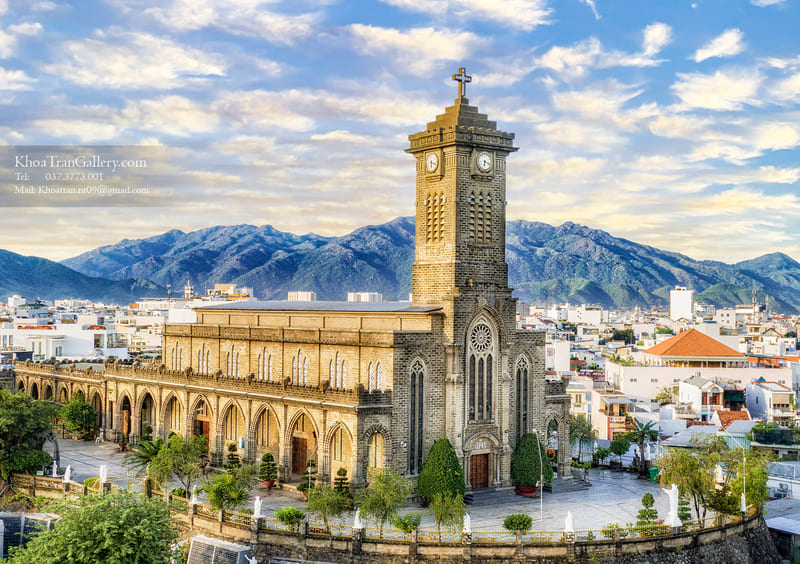
While not directly linked to Yersin’s scientific work, the Stone Cathedral (Christ the King Cathedral) is the architectural twin to his legacy. Built by Father Louis Vallet in the 1930s, it sits on a leveled hill overlooking the city.
The French Vibe: The Gothic arches, the rose windows, and the soaring bell tower are pure French. However, in a very "Yersin-esque" move of pragmatism, the "stone" is actually textured concrete—a local adaptation to the environment. It represents the spiritual side of the French legacy: a grand, ambitious vision executed with the humble materials of the land. It provides a vertical counterpoint to the horizontal sprawl of the bay, acting as a sentinel of peace in the middle of a bustling city.
6. Tactical Exploration: Following the Ghost of Yersin
To truly "inhale" the French legacy, you must move at a scientist's pace.
The Morning Walk: Start at the Pasteur Institute at 6:00 AM. Watch the sun rise over the bay, illuminating the yellow walls of the institute. This is when the "Slow Pulse" is most palpable.
The Hidden Villas: Head into the streets behind the Institute. Look for the "Quartier Français"—the small cluster of colonial-era villas that still stand. Many are now cafes or private homes, but their crumbling fences and bougainvillea-covered gates offer the most photogenic glimpses into the 1920s.
The Grave at Suoi Dau: For the true "Guru," a 20-kilometer trip inland to Suoi Dau is essential. This is where Yersin chose to be buried—in a simple grave overlooking the mountains and the agricultural station he founded. It is a place of profound silence and beauty, far removed from the neon lights of the modern beach. It is here that you realize Yersin’s greatest discovery wasn't a bacteria, but a way of living in harmony with this land.
THE FRENCH HERITAGE TOOLKIT
The "Science & Soul" Guided Walk: Explore the Pasteur Institute and Yersin’s hidden villas. 👉 [Insert Link Here]
Vietnamcharm’s Heritage Discovery: Professional audio guides and maps of the French "Grid." 👉 [Insert Link Here]
We are on social media
Vietnam Charm belongs to Vietpearl Travel., JSC
Contact:
Email: info@vietnamcharm.top
© 2026. by Vietnam Charm. All rights reserved
Travel license number: 01-827/2020
Refund Policy