Giảm giá hấp dẫn cho tour du lịch!


THE HEALING KITCHEN: TRADITIONAL VIETNAMESE MEDICINE — WHERE YIN AND YANG MEET HERBS, SPICES, AND THE PHILOSOPHY OF THE HEALING DISH
More than therapy: exploring Y Học Cổ Truyền (Traditional Vietnamese Medicine - TVM) as the nation’s ultimate philosophical art of longevity, analyzing its profound, unyielding reliance on the Âm-Dương (Yin-Yang) and Ngũ Hành (Five Elements) framework, its transformation of the Bếp (Kitchen) into the primary healing sanctuary, and its embodiment of holistic, compassionate, and preventive wellness.
VIETNAMESE CULTUREHEALTH & WELLNESSLOCAL EXPERIENCES
Tobin Nguyen
11/8/20256 phút đọc
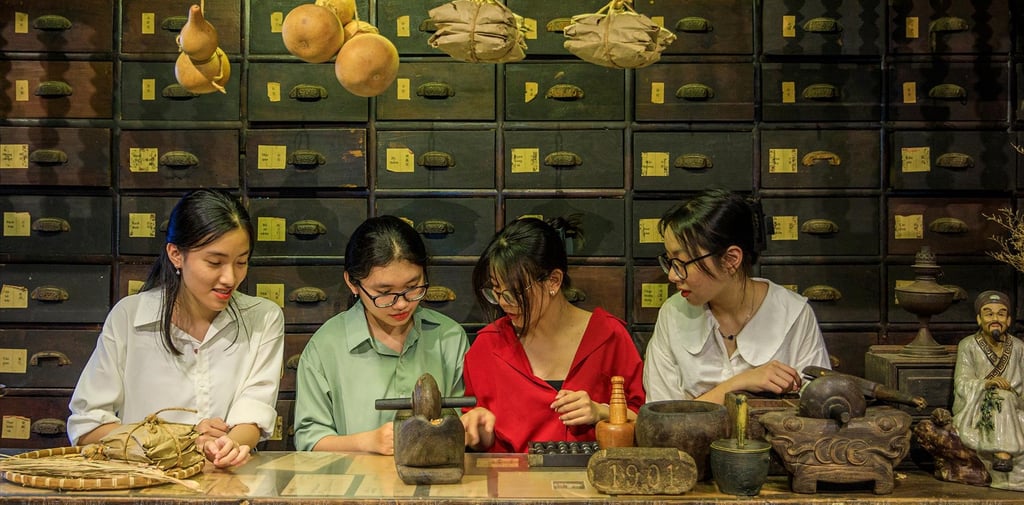
For the international medical scholar, the seeker of ancient wisdom, and the observer of daily cultural philosophy, Traditional Vietnamese Medicine (TVM or Đông Y) is not a mere set of historical practices; it is the nation’s most enduring, profound, and holistic philosophy of existence, where health is defined as the perfect, continuous, and dynamic balance of internal and external energies. TVM asserts an ultimate, non-negotiable truth: healing is not a sudden intervention, but a meticulous, lifelong cultivation—a daily, disciplined dialogue between the body’s internal landscape and the fluctuating forces of the cosmos. The traditional kitchen, therefore, is consecrated as the primary healing sanctuary, and every meal is transformed into a therapeutic contract, ensuring that food is perpetually viewed as the ultimate medicine.
As specialists in Vietnamese heritage and profound cultural analysis at Vietnam Charm, we embark on an essential, detailed exploration to decode this flowing, dynamic philosophy. We will meticulously analyze the cosmological mandate that embeds the Yin-Yang and Five Elements framework into every diagnosis, the structural genius of Dược Thiện (Healing Cuisine) as the core preventive strategy, the spiritual reverence for the Thảo Dược (Herbs) that transform the forest into the nation’s pharmacy, and the profound way this practice articulates the core national values of holistic balance, compassionate patience, and disciplined self-cultivation. Understanding TVM is essential to grasping the emotional heart and the spiritual integrity that underpins the Vietnamese approach to longevity.
1. The Cosmological Mandate: The Unyielding Framework of Yin-Yang and Five Elements
The foundation of Traditional Vietnamese Medicine is an absolute, non-negotiable cosmological mandate: the belief that the body is a microcosm that must perpetually reflect the harmonious, dynamic balance of the external universe, dictated by the twin pillars of Âm-Dương (Yin-Yang) and Ngũ Hành (Five Elements).
The Yin-Yang Dialectic: Health (sức khỏe) is defined as the perfect, fluid, and equal balance of Yin (Âm) energies (coldness, stillness, darkness, moisture, essence, representing organs like the Liver and Kidney) and Yang (Dương) energies (heat, activity, light, dryness, function, representing organs like the Stomach and Small Intestine). Illness (bệnh tật) is simply a manifestation of imbalance—a deficiency in Yin or an excess of Yang (or vice versa). The initial, crucial diagnostic act in TVM is never about identifying a pathogen; it is about locating the source of the energy imbalance and understanding the specific nature of the Yin or Yang disharmony.
The Five Elements (Ngũ Hành): This framework (Wood, Fire, Earth, Metal, Water) organizes the body's major organs, flavors, colors, emotions, and seasons into a dynamic, cyclical system of mutually generating and mutually controlling relationships. The diagnostic process maps the patient's symptoms onto this cycle (e.g., Liver/Wood is related to Anger and Spring). The healing process, therefore, is not a linear attack on disease; it is a circular, holistic effort to restore the entire network's flow and function, ensuring that the elements within the body are generating and controlling each other precisely as they should in the external cosmos. This framework elevates diagnosis from a medical task into a profound, spiritual act of interpreting cosmic order.
2. The Structural Genius: The Kitchen as Sanctuary and the Art of Dược Thiện
The most unique and powerful structural genius of Traditional Vietnamese Medicine is its elevation of the Bếp (Kitchen) as the primary healing sanctuary and the systematic reliance on Dược Thiện (Healing Cuisine) as the core, most accessible, and most profound preventive therapeutic tool.
Food as Medicine: TVM asserts that the most effective and gentle way to correct energy imbalance is not through concentrated, aggressive chemicals, but through the daily, meticulous calibration of diet. Every single ingredient—be it ginger, star anise, turmeric, or a specific type of vegetable—is classified according to its Yin-Yang profile (hot/cold/neutral) and its Ngũ Hành properties (which organ it affects). The act of cooking a traditional Vietnamese dish is thus an act of sophisticated biochemical engineering—balancing the cooling effect of duck or cucumber with the warming effect of ginger or lemongrass to create a dish of perfect, dynamic neutrality.
The Ritual of Dược Thiện: Healing Cuisine (such as specialized porridge, soups, and broths) transforms the ordinary meal into a highly potent, personalized therapeutic contract. Broths made with specific herbs, concentrated bone stock, and targeted spices are administered to warm a cold Yin deficiency or cool a fiery Yang excess. This emphasis ensures that the responsibility for wellness is decentralized from the professional physician (thầy thuốc) to the family and the home cook (người nội trợ). The daily meal becomes a continuous, proactive act of disciplined self-cultivation and preventative care, weaving the philosophy of health directly into the intimate fabric of domestic life.
3. The Material Source: Herbs, Earth, and the Spiritual Bond with Thảo Dược
The efficacy of Traditional Vietnamese Medicine relies intensely on the rich biodiversity of the tropical landscape and the spiritual reverence for the Thảo Dược (Herbs) that transform the forest and garden into the nation's decentralized pharmacy.
The Earth as Pharmacy: The practitioner (thầy thuốc) possesses a deep, inherited botanical literacy—an intimate, generations-old knowledge of thousands of local plants, their precise medicinal properties, the optimal time for their harvest, and the correct preparation methods (drying, fermenting, decocting) required to activate their healing power. The herbs are viewed not merely as chemicals, but as spiritual entities possessing Khí (energy) that must be respected and harmonized with the patient’s own energy. The forest, the mountains, and the simple family garden become the sacred, living repository of healing knowledge.
The Process of Preparation: The preparation of TVM remedies—often involving the meticulous sắc thuốc (decoction) of complex, multi-herb formulas (thang thuốc)—is a long, patient ritual. The formula is unique to the patient, precisely tailored to their specific Yin-Yang imbalance, and the slow, controlled process of boiling the mixture down to a concentrated essence mirrors the philosophical process of disciplined transformation. The patient's willingness to consume the often bitter, earthy liquid is itself an act of disciplined submission to the healing process and a physical covenant with the natural world.
4. The Therapeutic Body: Acupuncture, Massage, and the Flow of Khí
Beyond the internal remedy of herbs and food, Traditional Vietnamese Medicine relies on external, physical therapeutic methods—the Ngoại Khoa (External Therapies)—designed to directly manipulate the body’s energy flow, or Khí, and ensure the continuous, correct movement of the life force.
Acupuncture (Châm Cứu): This is the ultimate, precise therapeutic tool designed to bypass the digestive system and directly intervene in the body's energy network. The practitioner uses sterile needles to stimulate specific huyệt (acupuncture points) that lie along the invisible kinh mạch (meridians). The goal is to immediately unblock stagnated Khí, redirect energy from an area of excess (Yang) to an area of deficiency (Yin), and restore the dynamic, fluid balance of the system. The act is one of controlled, precise manipulation of the body's electrical and energetic architecture.
Traditional Massage (Xoa Bóp) and Cupping (Giác Hơi): These physical therapies are used to clear surface tension, stimulate blood flow, relax constricted muscles, and manually encourage the flow of Khí that has become stagnant. Massage is often used as a daily, preventative practice, ensuring that the physical body remains a flexible, unobstructed conduit for life energy. The overall therapeutic philosophy is that the body must be maintained as a flexible, open, and fluid vessel, allowing the healing energies of the cosmos, the earth (herbs), and the mind to move freely within the internal landscape.
5. Conclusion: The Permanent Testament to Holistic Balance
Traditional Vietnamese Medicine is the ultimate, enduring, and profound testament to the Vietnamese spirit's capacity for philosophical integration, ecological intimacy, and disciplined self-cultivation. It is a philosophy that transforms the chaos of symptoms into the clarity of cosmic imbalance. By analyzing the unyielding mandate of the Yin-Yang and Five Elements framework, the structural genius of Dược Thiện and the kitchen sanctuary, the spiritual reverence for the Thảo Dược and the decoction ritual, and the external therapeutic tools that manipulate the flow of Khí, the observer gains access to a core, luminous truth: TVM is far more than a set of historical cures. It is the permanent, unwavering declaration of holistic balance—a powerful, compassionate assertion that asserts the cultural value of disciplined self-cultivation, ecological respect, and the belief that the purest, most resilient form of health is achieved through the quiet, continuous, and dynamic harmony between the human spirit, the physical body, and the immense, living forces of the cosmos.
We are on social media
Vietnam Charm belongs to Vietpearl Travel., JSC
Contact:
Email: info@vietnamcharm.top
© 2026. by Vietnam Charm. All rights reserved
Travel license number: 01-827/2020
Refund Policy