Giảm giá hấp dẫn cho tour du lịch!


THE HORIZON'S CONTRACT: VIETNAMESE FISHING VILLAGES — DECODING THE UNSPOKEN VOW, PRIMAL FAITH, AND THE SOUL OF THE COASTAL CRUCIBLE
More than labor: exploring the Làng Chài (Fishing Village) as Việt Nam’s ultimate frontier civilization, analyzing the profound unspoken contract between man and the eternal ocean, its spiritual infrastructure of Whale Worship (Thờ Cá Ông), and its embodiment of fierce self-reliance, collective discipline, and lyrical humility before the sublime.
VIETNAMESE CULTURETHE WATER CIVILIZATIONLOCAL EXPERIENCES
Tobin Nguyen
11/8/20256 phút đọc
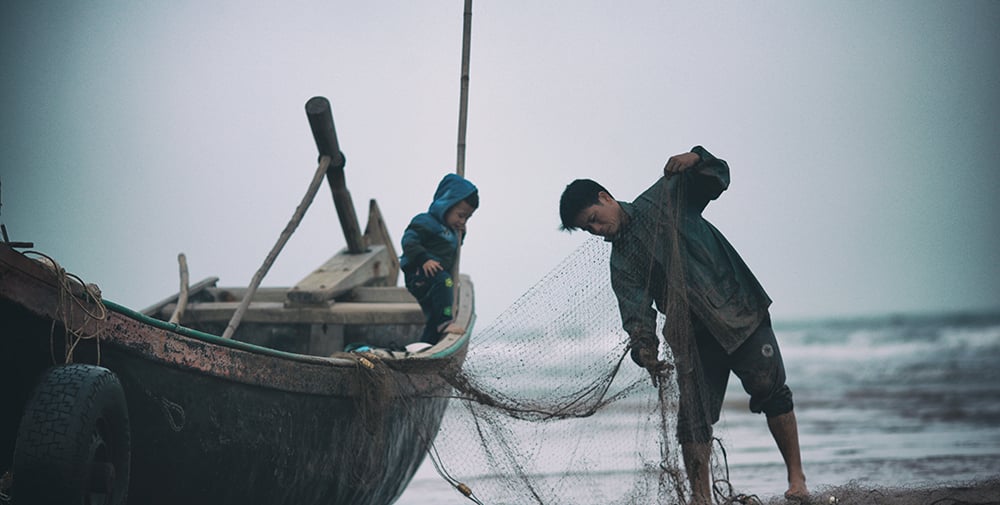
For the cultural observer, the Vietnamese Fishing Village (Làng Chài) is not merely a geographic location on the coast; it is a profound, spiritual crucible—a community forged in the relentless confrontation with the horizon's immensity. These villages, scattered across thousands of kilometers of coastline, represent Việt Nam’s fiercest frontier, where life is dictated by the unpredictable rhythm of the wind, the tide, and the terrifying, sublime power of the sea. The existence here is a high-stakes gamble, a daily renewal of an unspoken contract: the ocean provides sustenance, but only in exchange for constant vigilance, profound respect, and the perpetual risk of total loss. This demanding environment shapes a human spirit unlike any other—one defined by lyrical melancholy, practical ingenuity, and a spiritual faith as vast and deep as the water itself.
As specialists in Vietnamese heritage and profound cultural analysis at Vietnam Charm, we embark on an essential, detailed exploration to decode this elemental life. We will meticulously analyze the primal contract that defines the fisherman's psychological state, the spiritual architecture that anchors their collective fear in sacred belief (Whale Worship), the architectural humility of their coastal existence, and the profound way this civilization articulates the core national values of resilience, collectivism, and a deep, poetic reverence for the uncontrollable forces of nature. Understanding the Làng Chài is essential to grasping the emotional weight, the enduring courage, and the spiritual depth of Việt Nam’s maritime soul.
1. The Primal Contract: Confrontation, Humility, and the Elemental Fear
The psychological and emotional landscape of the Vietnamese fisherman is defined by a singular, constant reality: the unpredictable, primal confrontation with the sea. This environment mandates a unique form of daily courage, balanced by an immense, non-negotiable humility.
The sea, for the Làng Chài, is the ultimate paradox: the source of all life and the constant architect of death. Every single journey beyond the harbor mouth is an intentional breach of the land's safety, a direct confrontation with the sublime power of a primal element. This daily risk instills a philosophical gravity in the community. There is no room for arrogance; human plans are meaningless when measured against the sudden wrath of a typhoon or the caprice of the currents. This necessitates the ultimate form of existential humility—a recognition that survival is not guaranteed by strength or skill alone, but by a form of blessed luck (may mắn) granted by the spiritual powers of the deep.
This environment forges a soul that is both fiercely independent (the lone boat against the horizon) and profoundly collective (the reliance on the village for rescue and support). The fisherman's bravery is quiet, internalized, and woven into the routine of checking the nets and reading the clouds. It is a form of courage that transcends heroism; it is simply the enduring necessity of survival itself. This life is a lyrical saga written in the salt-stained silence between the wave crests—a testament to human perseverance at the very edge of the map.
2. The Spiritual Architecture: Thờ Cá Ông and the Sanctity of the Deep
The emotional burden of the fisherman's life—the constant terror of the storm, the fear of loss, the immense solitude—is managed and channeled through a magnificent, uniquely Vietnamese spiritual architecture, anchored by the reverence for the Whale.
The tradition of Thờ Cá Ông (Whale Worship), where Cá Ông (Lord Whale) is seen not as an animal but as the benevolent, powerful spiritual protector (thần) of the fisherman, is the most profound expression of this spiritual necessity. According to ancient belief, the Cá Ông sacrifices itself to guide lost boats, calms the roughest seas, and protects vessels from the ocean's malevolence. When a whale washes ashore, it is treated with the highest funeral rites (Lễ Tang) due a village elder or a revered ancestor, and its bones are enshrined in the Lăng Ông (Whale Temple)—the undisputed spiritual heart of the fishing village.
The annual Lễ hội Cầu Ngư (Whale Festival) is not a mere celebration; it is a mandatory, high-stakes ritual of spiritual contract renewal. Through offerings, drumming, and ceremonial singing, the community collectively thanks the Cá Ông for the bounty and begs for continued protection for the perilous journeys ahead. This spiritual system transforms the unpredictable ocean into a spiritual realm supervised by a benevolent guardian, providing a tangible psychological anchor against the existential fear of the vast, open water. Faith, in the Làng Chài, is not abstract; it is a life-or-death survival mechanism.
3. The Architecture of Resilience: The Basket Boat and the Humility of Structure
The physical and structural existence of the Làng Chài reflects the profound humility and practicality mandated by the coastal environment. Architecture is stripped down to its most necessary, resilient form.
The homes and docks are not built for permanence or luxury; they are built to withstand and yield—pragmatic, simple structures often constructed with locally sourced wood, concrete, and salvaged materials, capable of being repaired quickly after the frequent wrath of coastal storms. The entire village cluster often exists in a state of organized, resilient impermanence, prioritizing the survival of the community over the endurance of the individual building.
The most potent symbol of this resilience is the Thuyền Thúng (Basket Boat). This round, woven bamboo craft, coated with resin to make it waterproof, is the quintessential tool of the coastal fisherman. It is small, simple, and utterly dependent on the skill of its single user. The Thuyền Thúng represents the ultimate expression of self-reliance—a singular vessel where the fisherman, using only a paddle, confronts the powerful surf. Its circular shape, which allows it to ride the waves instead of cutting through them, is a profound architectural statement of the Làng Chài philosophy: adapt to the elemental force, do not fight it. This humble basket boat embodies the fierce independence and the quiet courage of its master, sailing to the edge of the known world with only bamboo and resin beneath their feet.
4. The Collective Pulse: Mutual Dependence and the Hàng Xóm Láng Giềng
The successful survival of the Làng Chài is entirely dependent on the ferocious, non-negotiable collective pulse that binds the community—a level of mutual dependence (hàng xóm láng giềng) that transcends simple friendship to become a sacred, life-saving covenant.
In the unforgiving environment of the sea, the individual's fate is constantly entwined with the collective's fate. A lone boat in trouble cannot survive without the immediate, synchronized mobilization of the entire village for rescue. This necessity for instant, reliable, collective aid shapes the social fabric. Property, catch, and hardship are often shared, not out of communist ideal, but out of pragmatic survival logic: a healthy community ensures the survival of its individuals. The women of the village, often running the docks, managing the nets, and selling the daily catch, function as the essential economic and social anchor, maintaining the stable rhythm of life while the men are absent on the high seas.
The concept of lòng nhân ái (profound compassion) here is an active, mandatory duty. The strongest emotional bond is not romantic passion, but the fierce, quiet loyalty between those who have faced the horizon together. The sadness of loss, when a boat does not return, is a collective grief, because every member understands that their turn may be next. This shared fate transforms the village into a single, beating heart, pumping life and courage to the edge of the world.
5. Conclusion: The Permanent Testament to Lyrical Courage
The Vietnamese Fishing Village is the ultimate, enduring testament to human fortitude, spiritual depth, and the resilience forged at the interface of land and sea. It is a civilization that transforms the challenge of the primal element into a source of profound, lyrical courage. By analyzing the psychological confrontation of the primal contract, the spiritual anchor provided by the sacred Cá Ông, the architectural humility of the basket boat, and the fierce, life-saving collective pulse, the observer gains access to a core truth: the Làng Chài is far more than a source of seafood. It is the permanent, unwavering saga of lyrical courage—a profound, emotional declaration that asserts the cultural value of disciplined humility, ancient faith, and the belief that the human spirit, armed with only a woven boat and fierce loyalty, can stare into the immense terror of the horizon and return with life and hope. The smell of the salt and the sound of the wave crests are the rhythm of the nation's most resilient heart.
We are on social media
Vietnam Charm belongs to Vietpearl Travel., JSC
Contact:
Email: info@vietnamcharm.top
© 2026. by Vietnam Charm. All rights reserved
Travel license number: 01-827/2020
Refund Policy