Giảm giá hấp dẫn cho tour du lịch!



THE LIQUID STAGE: WATER PUPPETRY — DECODING THE ANCIENT RITUAL, AGRARIAN HUMOR, AND THE HIDDEN ART OF THE PUPPETEER
More than spectacle: exploring Múa Rối Nước as Việt Nam's ultimate agrarian theatrical tradition, analyzing its genesis as a harvest ritual, its profound reliance on the aqueous stage, and its embodiment of collective spiritual memory, humor, and technical ingenuity.
VIETNAMESE CULTURETHE WATER CIVILIZATIONLOCAL EXPERIENCES
Tobin Nguyen
11/8/20255 phút đọc
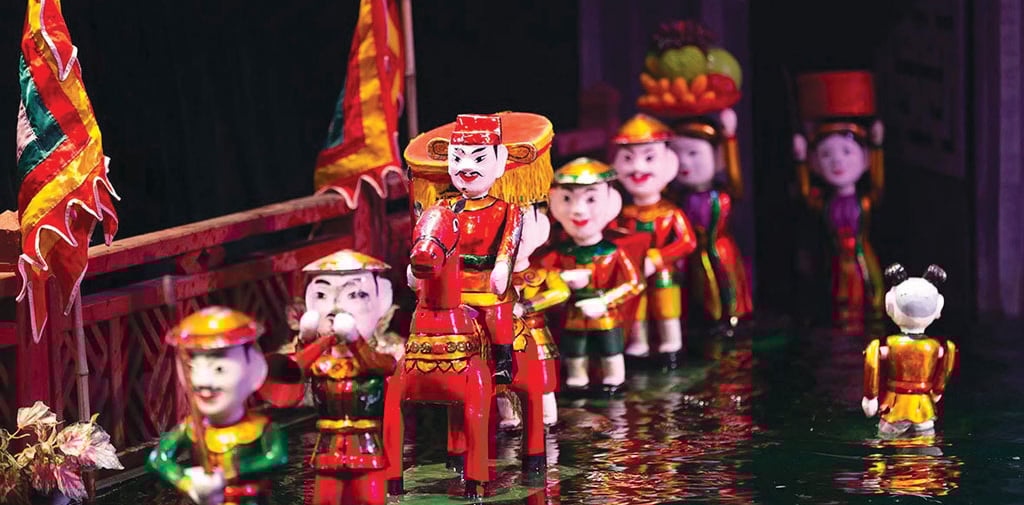
For the international audience, Múa Rối Nước (Water Puppetry) presents itself as a mesmerizing, deeply whimsical theatrical form—a unique art where wooden puppets dance, swim, and battle upon a watery stage, often shielded by a traditional temple facade. This tradition, originating in the Red River Delta over a thousand years ago, is far more than mere entertainment; it is the nation's quintessential agrarian theatre, a living, direct expression of the Vietnamese relationship with the water, the rice paddy, and the spiritual world. The art form is defined by a profound paradox: an intensely visible performance enacted by a completely hidden human mechanism, demanding immense skill, resilience, and collaborative discipline.
As specialists in Vietnamese heritage and profound cultural analysis at Vietnam Charm, we embark on an essential, detailed exploration to decode this liquid stage. We will meticulously analyze the historical mandate that linked the art to the rice harvest, the structural genius of the aqueous stage and the concealment of the puppeteer, the narrative function of its traditional repertoire (spanning farming to royal epic), and the profound way Water Puppetry articulates the core values of ingenuity, collective resilience, and the essential humor that sustained life in the ancient rice civilization. Understanding Water Puppetry is essential to grasping the emotional honesty and the technical mastery of Vietnamese folk culture.
1. The Historical Mandate: Rice, Water, and the Ritual of the Harvest
The genesis and profound structure of Múa Rối Nước are rooted in the ancient spiritual and agrarian necessity of the Red River Delta—the need to honor the water spirits, invoke blessings for the rice harvest, and celebrate the end of arduous labor. The art form is directly tied to the cycle of the wet-rice civilization.
Historical records trace the tradition back to the 11th century, where performances were initially conducted in the communal pond (ao làng) or flooded rice fields (ruộng lúa). The art served as a sacred ritual of thanksgiving to the Thần Nước (Water Spirits), who were believed to govern the rain and the flow of the rivers, and whose benevolence was crucial for the survival of the village. The performance was often incorporated into the major Spring and Autumn Lễ Hội (Festivals), transforming the agricultural space into a temporary spiritual stage. The water itself—the same element that sustained the rice—was revered and utilized, making the performance an act of profound environmental reverence.
The use of water as the stage is the single most defining feature and the core philosophical statement of the art. The water serves multiple functions: it acts as a literal stage for the floating puppets, it visually conceals the intricate mechanisms and the puppeteers themselves, and it acoustically enhances the sound of the wooden figures, giving the performance an ethereal, magical quality. This fusion of utility and mystique elevates the tradition from a simple show to a powerful, fluid spiritual communication platform.
2. The Structural Genius: Concealment, Hydro-Acoustics, and the Thủy Đình
The structural genius of Water Puppetry lies in the meticulously engineered design of its stage and the disciplined, unseen positioning of the human element. The entire mechanism is an architectural paradox built on concealment and control.
The stage is the Thủy Đình (Water Pavilion)—a small, traditional-style temple structure built directly into the water, typically replicating the architecture of the Đình Làng (Communal House). This pavilion serves three key functions: it is the visual backdrop, often adorned with flags and banners; it houses the accompanying live orchestra; and, most crucially, it provides the concealment area for the puppeteers. A heavy screen or curtain hangs from the pavilion, reaching just above the water line, completely hiding the puppeteers and their intricate mechanisms from the audience.
The puppeteers work waist-deep in the water (Gầm Đình), manipulating the large, lacquered wooden puppets using a complex system of long rods, strings, and levers hidden beneath the surface. This operation demands extraordinary physical stamina, collaborative synchronicity, and precise hydrological knowledge, as the puppeteers must work in continuous, synchronized motion in the water—a medium that constantly resists stable movement. The water itself acts as a hydro-acoustic amplifier, carrying the rhythmic clatter of the wooden figures and the submerged mechanisms to the audience, enhancing the sense of mystery and magic. The performance is thus a profound testament to the invisible, collective discipline required to create visible, fluid grace.
3. The Narrative Function: Agrarian Humor and the Chronicle of Daily Life
The traditional repertoire of Water Puppetry is a living chronicle of Vietnamese agrarian life, transforming the mundane tasks of the village into a highly stylized, humorous, and spiritually resonant theatre. The narratives are fundamentally honest and accessible to the common person.
The most common themes are drawn directly from the daily life of the rice-based civilization:
Farming and Labor: Scenes depicting the ploughing of the field, the planting of rice, the catching of frogs, or the raising of ducks. These scenes are infused with a gentle, often slapstick agrarian humor, celebrating the necessary hardships and the shared effort of communal labor.
Mythology and Legend: Reenactments of ancient Vietnamese legends, such as the story of the Lê Lợi's magic sword (Hoàn Kiếm Legend) or the mythical origins of the nation, reinforcing national memory and patriotic pride.
Spiritual Ceremony: Performances depicting dragon dances, lion dances, and the playful mischief of the Chú Tễu (The Jester)—the central, beloved character who serves as the bridge between the audience and the spiritual world, often offering commentary and humor with sharp, simple wit.
The role of Chú Tễu is sociologically critical. As the master of ceremonies, the jester is the only human figure visible above the water (before the main curtain opens), often engaging in lively, improvised dialogue with the audience. His wit, humor, and simple peasant dress allow him to offer social commentary and subtle critique with impunity, acting as a crucial valve for communal opinion in a way that formalized theater could not. The art form is thus a powerful mechanism for both communal memory and collective emotional release.
4. The Craftsmanship: Lacquer, Lightness, and the Puppet's Soul
The creation of the Rối Nước (Water Puppets) is a highly specialized craft that demands ingenuity, artistic mastery, and a profound understanding of the water medium. The puppet is far more than a simple wooden doll; it is a floating, functional sculpture.
The puppets are meticulously carved from lightweight fig wood (gỗ sung), chosen for its natural buoyancy and its resilience against continuous exposure to water. They are then finished with multiple, protective layers of durable lacquer paint (sơn mài), ensuring their vibrant colors and intricate details (clothing, facial expressions) survive the constant submersion. The size and shape of the puppets are engineered to maintain a precise balance between floating stability and fluid movement when manipulated by the submerged rods.
The artistry lies in the expressive simplicity of the puppet’s face. Unlike realistic Western puppetry, the Rối Nước figures utilize a stylized, simple, and often fixed expression that immediately communicates the character's role (hero, villain, farmer, jester). This simplicity allows the puppet's motion—the fluid, dynamic movement provided by the water—to convey the main emotional narrative. The puppet is essentially a functional hydro-sculpture, with its aesthetic value tied directly to its functional capacity to dance on the liquid stage. The preservation of this craft requires the continuous passing down of the specialized knowledge of wood selection, carving, and lacquering techniques.
5. Conclusion: The Permanent Testament to Ingenuity
Múa Rối Nước is the ultimate, enduring theatrical testament to the ingenuity, spiritual depth, and resourcefulness of the Vietnamese spirit. It is an art form that transforms the agricultural water—the source of life—into a stage for storytelling, humor, and spiritual communion. By analyzing the historical mandate that rooted the art in the harvest ritual, the structural genius of the hidden puppeteer and the acoustic water stage, the narrative function of its agrarian humor, and the technical mastery required to carve its functional figures, the observer gains access to a core truth: Water Puppetry is far more than a spectacle. It is a permanent, powerful declaration of cultural resilience—a fluid, magical theatre that asserts the cultural value of disciplined ingenuity, collective effort, and the belief that the most beautiful, enduring art is that which is created in perfect, humorous harmony with the essential forces of the natural world.
We are on social media
Vietnam Charm belongs to Vietpearl Travel., JSC
Contact:
Email: info@vietnamcharm.top
© 2026. by Vietnam Charm. All rights reserved
Travel license number: 01-827/2020
Refund Policy