Giảm giá hấp dẫn cho tour du lịch!


THE TRIBAL CATHEDRAL: THE NHÀ RÔNG — DECODING THE VERTICAL AXIS OF COSMOLOGY, COLLECTIVE AUTHORITY, AND SACRED MASCULINITY IN THE CENTRAL HIGHLANDS
More than a structure: exploring the Nhà Rông as the profound architectural anchor of the Central Highlands village, analyzing its soaring, unique verticality, its role as the non-negotiable nexus of ceremony, justice, and spiritual communion, and its embodiment of ethnic identity and collective resilience.
LOCAL EXPERIENCESVIETNAMESE CULTURETHE ARCHITECTURAL SOUL
Tobin Nguyen
11/6/20256 phút đọc
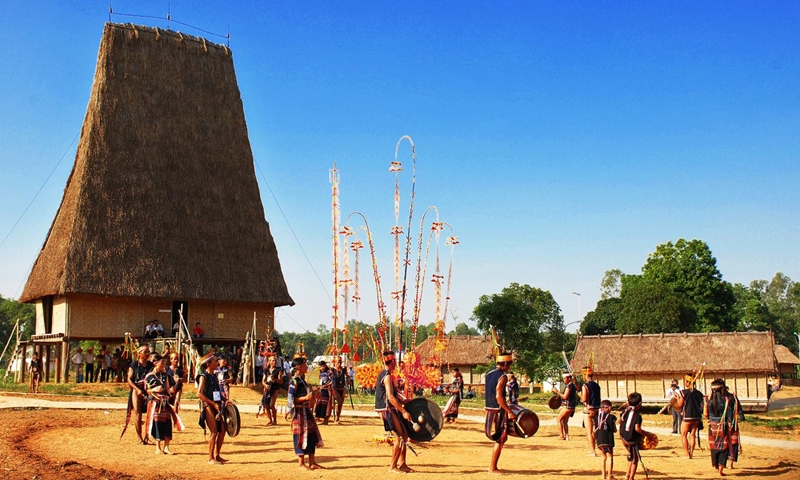
For the cultural observer venturing into the deep, mist-shrouded jungles and undulating plateaus of Việt Nam’s Central Highlands, the landscape is punctuated by a structure unlike any other in Southeast Asia: the Nhà Rông (Communal House). This towering, majestic, and structurally unique edifice, characteristic of the Ba Na, Gia Rai, Xê Đăng, and related ethnic groups, is not merely a meeting place. It is the single most important physical and spiritual artifact of the Pleiku (village)—a tribal cathedral, a civic parliament, a museum of history, and the absolute axis mundi that anchors the entire cosmos of the community. Its immense, soaring, upward-sweeping roof is a permanent, silent declaration of the village’s collective identity, its wealth, and its unwavering connection to the sky gods and the ancestors.
As specialists in Vietnamese heritage and profound cultural analysis at Vietnam Charm, we embark on an essential, detailed exploration to decode this philosophy of monumental elevation. We will meticulously analyze the cosmological imperative that dictates its spectacular verticality, the architectural mastery of its communal construction and thatched roof, the sociological structure that defines its internal use as the sanctuary of the elders and the sacred masculine, and the profound way this singular, towering structure articulates the ethnic groups' commitment to collective discipline, ritual sacrifice, and profound spiritual continuity. Understanding the Nhà Rông is essential to grasping the core mechanisms of governance, ritual, and spiritual life in the Central Highlands.
1. The Cosmological Imperative: Verticality as an Axis Mundi
The defining characteristic of the Nhà Rông is its spectacular, often dizzying verticality—a height that far exceeds any practical necessity for mere shelter or protection. This elevation is not an aesthetic choice; it is a cosmological imperative, making the Nhà Rông the physical manifestation of the Axis Mundi (The World Axis), which connects the three realms of the universe.
In the belief systems of the Central Highlands groups, the cosmos is divided into three distinct vertical planes: the Sky/Heavens (Upper World), the Earth/Forest (Lower World), and the Human Realm (Middle World). The Nhà Rông is the sole structure sanctioned to actively and visibly bridge these three realms. The tip of its massive, tapering roof is the point of contact with the Sky Gods (Giàng), acting as the village’s permanent spiritual antenna, drawing down benevolent energy and rain. The raised communal floor is the realm of Man, the space for civil conduct, ritual, and dialogue. The space beneath the Rông (Gầm Nhà) is the sacred boundary with the Earth and the forest, where offerings are sometimes placed and where the mundane tasks of daily life meet the wild.
The height of the Nhà Rông is therefore a direct, tangible measure of the village's spiritual vitality, wealth, and pride. A new Nhà Rông must be built higher than its predecessor and certainly higher than any house in the surrounding villages, asserting the community’s spiritual and political dominance. The architectural act is thus inherently a theological declaration—a structural commitment to maintaining an unhindered, visible line of communication between the community and the divine. The structure is built to defy the horizontal plane of the jungle, establishing the vertical sovereignty of the human spirit.
2. The Architecture of Scale: Collective Effort and the Soaring Roof
The construction of the Nhà Rông is perhaps the ultimate example of architecture as a collective, ritualistic act—a monumental undertaking that requires the disciplined mobilization of the entire village's labor, wealth, and resources (làm rông). This collective effort imbues the structure with a powerful, communal soul.
The most visually stunning feature is the Mái Rông (Rông Roof). Constructed from layers of meticulously woven thatch (often cỏ tranh), the roof is massive, heavy, and engineered to sweep dramatically upward, often resembling a great boat’s prow or a warrior’s uplifted shield. This shape is not arbitrary; it is a profound aesthetic of defiance and protection. The roof’s immense size and steep slope are practical, designed to shed the heavy monsoonal rains instantly, but its symbolic power is far greater. It physically and symbolically shelters the entire village's collective memory, political authority, and sacred artifacts.
The structure relies on a handful of Cột Cái (Main Pillars), which are massive logs selected with great reverence from the forest and hauled to the village through ritual procession. The pillars are structurally vital, but their primary function is spiritual, acting as the foundation for the spiritual axis discussed previously. No single family or individual could ever afford the labor or materials for such a scale; the Nhà Rông is the architectural testament to the uncompromising power of collective discipline. Its permanence and immensity stand in deliberate, forceful contrast to the smaller, more fragile family Nhà Sàn that surrounds it, asserting the priority of the collective over the individual household.
3. The Sociological Function: The Sanctuary of the Elders and Sacred Masculinity
The internal space of the Nhà Rông is governed by a strict, non-negotiable sociological and gender hierarchy, functioning primarily as the Sanctuary of the Elders and the Sacred Masculine—the non-negotiable seat of political and judicial power.
Historically, the Nhà Rông served as the exclusive domain for the Già Làng (Village Elders) and the unmarried young men.
The Political Seat: The Elders, who govern the village based on ancestral custom (Luật Làng), gather here daily to deliberate on matters of justice, resource allocation (water, land use), and ritual schedule. The floor plan is arranged to enforce this hierarchy, with the Elders occupying the most central, most spiritually potent positions near the hearth or the main drum.
The School of Men: Unmarried young men are traditionally required to sleep in the Nhà Rông until they marry. This is their school of moral conduct and warrior training. They learn the complex customary law, the history of the clan, the protocols of warfare, and the necessary discipline of communal living under the direct, constant supervision of the Elders. The Nhà Rông is the institution that manufactures responsible, disciplined men for the community.
Gender Protocol: Traditionally, women were severely restricted or entirely forbidden from entering the Nhà Rông except during major communal festivals, and then only to perform specific, mandated roles. This exclusion reinforces the structure’s role as the central reservoir of public, political, and defensive authority, which was historically reserved for the masculine domain.
Thus, the architecture physically codifies the political structure, ensuring that power, knowledge, and defense are centralized and ritually maintained by the male lineage.
4. The Ritual Nexus: The Hearth, The Gong, and the Contract with the Spirits
The Nhà Rông is the absolute, non-negotiable Ritual Nexus of the village, the only location capable of hosting the massive, profound ceremonies that renew the community's spiritual contract with the ancestors and the Sky Gods.
The center of the Nhà Rông is often dominated by the Bếp Lửa (Communal Hearth) and the storage area for the village’s most prized, sacred possessions—the Gong Sets (Cồng Chiêng) and the ceremonial drums.
The Sacred Hearth: The hearth is the unblinking eye of the community, never allowed to fully die out. Its continuous warmth symbolizes the eternal life and unity of the village. All communal meals, sacrifices, and the drinking of Rượu Cần (fermented rice wine) radiate from this central point, establishing a deep sense of shared sustenance and spiritual continuity.
The Gong: The highly valued gong sets are the voice of the spirits and the ancestors. They are stored in the Nhà Rông because they are considered too sacred and too powerful to be kept in individual homes. Their music is the essential, rhythmic language used to communicate with the Sky Gods during the great Lễ Hội (Festivals), marking important passages like the harvest, the water buffalo sacrifice, or the new rice celebration.
During a festival, the Nhà Rông transforms into a space of high drama, intense sound, and profound collective emotion. It is where the community's wealth (sacrificed animals, immense quantities of rượu cần) is ritually consumed, ensuring that the wealth is not merely hoarded, but shared and transformed into spiritual merit. The architecture creates the perfect container for this collective, ecstatic renewal of identity.
5. Conclusion: The Unwavering Anchor of the Collective Soul
The Nhà Rông is the ultimate, most powerful architectural expression of collective identity and spiritual sovereignty in the Central Highlands. It is a structure of necessity transformed into an indelible monument to the soul of the community. By analyzing the cosmological imperative that drives its magnificent verticality, the collective effort required to raise its soaring roof, the strict social discipline codified within its walls, and its role as the non-negotiable nexus for all major rituals, the observer gains access to a core truth: the Nhà Rông is not a building; it is a permanent, spiritual being that lives and breathes with the village. It is the visible, structural declaration of the belief that the strength, fate, and continuity of the individual are eternally subordinate to, and fundamentally protected by, the greater, unwavering power of the disciplined collective. The soaring roof stands as a testament to the unyielding resilience of the Highland spirit, perpetually reaching for the sky.
We are on social media
Vietnam Charm belongs to Vietpearl Travel., JSC
Contact:
Email: info@vietnamcharm.top
© 2026. by Vietnam Charm. All rights reserved
Travel license number: 01-827/2020
Refund Policy