Giảm giá hấp dẫn cho tour du lịch!



THE TWO-WHEELED ECOSYSTEM: MOTORBIKES — THE VEHICLE OF FREEDOM, LOGISTICS, AND URBAN CHAOS IN THE VIETNAMESE METROPOLIS
More than transport: decoding the profound sociological, economic, and philosophical role of the xe máy as the essential artery of Vietnamese urban life, exploring how perceived chaos operates under an invisible, complex code of collective spatial negotiation.
URBAN & DAILY LIFELOCAL EXPERIENCES
Tobin Nguyen
11/6/20255 phút đọc
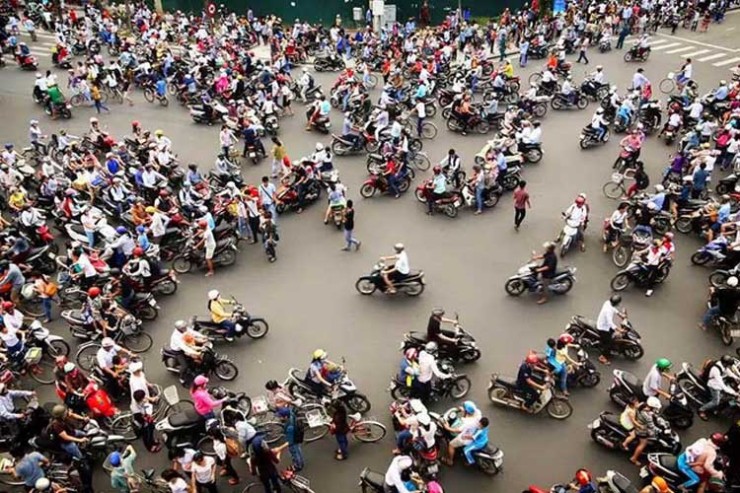
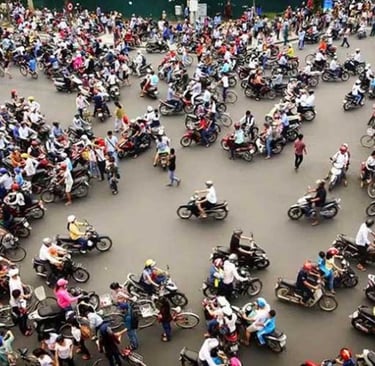
For the international visitor, the overwhelming, ceaseless roar of the motorbike (xe máy) is the singular, defining acoustic signature of any Vietnamese metropolis—a sensory experience that is exhilarating, intimidating, and often incomprehensible. The sheer volume of traffic, its fluidity, and its continuous motion transform the streets of Hà Nội and Ho Chi Minh City into complex, dynamic rivers of steel and human ingenuity. Yet, the motorbike is far more than a pervasive mode of transport; it is the foundational logistical spine of the economy, the ultimate symbol of individual economic freedom, and the most democratic platform for engaging with the rhythm of urban life. The perceived chaos is, in fact, an intricate, highly functional code of collective spatial negotiation mastered by every citizen.
As specialists in Vietnamese heritage and profound cultural analysis at Vietnam Charm, we embark on an essential, detailed exploration to decode this two-wheeled ecosystem. We will meticulously analyze the historical and economic necessity that elevated the motorbike to its supreme status, the sociological code that governs its seemingly anarchic movement, the urban planning challenges it presents, and the profound philosophical role the xe máy plays in articulating the adaptability, resilience, and fierce individualism of the modern Vietnamese spirit. Understanding the motorbike culture is essential to grasping the true pace, structure, and logistical genius of the Vietnamese metropolis.
1. The Economic Imperative: Necessity, Freedom, and the Rise of the Metropolis
The motorbike's supremacy in Việt Nam is rooted in a unique intersection of historical necessity, economic reality, and logistical superiority that made it the perfect vehicle for a rapidly industrializing nation.
The rise of the motorbike coincided directly with the post-Đổi Mới (Renovation) economic boom of the late 1980s and 1990s. As the economy rapidly liberalized, the burgeoning middle class needed a form of transport that offered personal, immediate economic autonomy without the prohibitive cost or required infrastructure of cars or public transit. The xe máy was the perfect solution: it was affordable, fuel-efficient, easy to maintain, and critically, perfectly sized to navigate the narrow, complex, and ancient alleyways (hẻm) and dense streets of the historic cities. The bike became the first, most accessible piece of capital investment for millions of families, serving as the primary logistical tool for commerce, commuting, and personal freedom. It literally drove the economic transformation of the nation.
The motorbike functions as a universal logistical platform. It is capable of transporting goods, services, and entire families that defy Western notions of capacity. It acts simultaneously as a family car, a cargo truck, a mobile storefront, and an emergency ambulance. This unrivaled versatility has cemented the motorbike's role not just as transport, but as the indispensable artery of the micro-economy, enabling millions of independent vendors and small businesses to operate with maximum efficiency across complex urban terrains. The xe máy is thus intrinsically linked to the fierce entrepreneurial spirit that defines modern Vietnamese commerce.
2. The Sociological Code: Collective Movement and the Invisible Flow
For the uninitiated observer, the movement of motorbikes appears to be pure chaos, defined by noise and near-misses. However, this appearance belies an incredibly sophisticated, highly refined sociological code of collective spatial negotiation that ensures remarkably few accidents occur relative to the volume of traffic.
The key to this code is fluidity and prediction, not rigid adherence to lane markers or static rules. The system operates on the principle of mutual observation and constant, low-speed adjustment. Unlike Western driving, which relies heavily on high speed, static distance, and explicit signaling, Vietnamese motorbike culture relies on continuous, subtle, non-verbal communication: a slight shift in shoulder, a gentle acceleration, or a fleeting glance informs every surrounding driver of an impending move. This creates a collective, dynamic "flow" where individuals constantly occupy and vacate space, moving as a single, multi-cellular organism.
The process of crossing the street, often terrifying for tourists, is the perfect illustration of this code. The pedestrian must not stop; they must step into the flow with a slow, predictable speed. The drivers do not stop either; they negotiate the space around the pedestrian, treating the individual as a predictable obstacle in their continuous, fluid path. This requires intense, mutual focus and a collective agreement on the primacy of continuous motion over aggressive stopping. The shared, low-speed movement is the essential mechanism that facilitates continuous commerce and high-volume urban life.
3. The Architecture of Sound and Space: The Urban Symphony
The pervasive presence of the motorbike has fundamentally dictated the architecture of sound and space within the Vietnamese metropolis, shaping the human interaction with the built environment.
The dominant soundscape of the city is the unrelenting roar of low-displacement engines and the constant, essential honking of horns. The horn in Việt Nam is not typically an expression of anger or aggression; it is a vital tool for spatial communication—a simple, polite sonic warning that communicates "I am here, and I am maintaining my speed." This acoustic environment means the city is perpetually dynamic and acoustically dense, demanding constant sensory attention from its inhabitants.
Spatially, the motorbike has defined the architecture of the city. The famous vỉa hè (sidewalks) have been colonized by the xe máy. Sidewalks function not primarily as pedestrian pathways, but as necessary, flexible parking and staging grounds for the millions of bikes. This appropriation necessitates that pedestrians share the street with the traffic, further integrating them into the motorbike's fluid ecosystem. Furthermore, the architecture of the ống nhà (tube house) is influenced by the motorbike; the ground floor is often completely dedicated to parking and storing the family's fleet, visually and physically cementing the vehicle's essential status within the domestic structure.
4. The Philosophical Significance: Freedom and Resilience
Beyond logistics and economy, the xe máy embodies a profound philosophical statement on personal freedom, self-reliance, and national resilience.
The motorbike is the ultimate tool of individual empowerment. It provides the owner with total logistical freedom, bypassing the rigid schedules and fixed routes of public transit. This personal mobility is a crucial psychological asset in a culture that values self-reliance and the ability to personally connect with family or seize immediate economic opportunity across the sprawling urban landscape. The xe máy is, in essence, the modern Vietnamese citizen's immediate connection to the ideals of freedom and enterprise.
Furthermore, the culture of the motorbike reflects the nation's profound adaptability and ingenuity. The ability of the populace to master the chaotic, high-volume flow of traffic and create a functioning, complex logistical system with minimal formal enforcement speaks to a collective genius for improvisation and negotiation. The shared reliance on predicting the actions of others fosters a kind of compulsory collective spirit—a resilience born from the shared necessity of survival and commerce on the fast-moving river of traffic. The xe máy is a daily, physical manifestation of the nation’s unyielding drive.
5. The Future and Preservation: Mastering the Transition
The motorbike culture faces an inevitable, complex transition as Việt Nam's cities rapidly develop and mature. The immense volume of bikes is becoming ecologically and spatially unsustainable, necessitating a gradual shift towards higher-capacity public transit.
However, this transition is profoundly complex because the xe máy is deeply integrated into the economic and cultural fabric. Replacing the motorbike requires not just the construction of metro lines, but the replacement of the motorbike's unique logistical versatility—its ability to deliver tiny packages, navigate narrow alleys, and act as a multi-functional cargo platform. The preservation of the xe máy culture, therefore, lies not in maintaining its overwhelming numbers, but in documenting its intricate, invisible social code. Ethnographers and urban planners must study the fluidity, the negotiation techniques, and the non-verbal communication that define this unique system before it is replaced by the rigid, formalized structures of Western-style urban planning. The lessons learned from the xe máy era—adaptability, collective prediction, and continuous motion—will be vital for the future of any dense metropolis.
The motorbike is the ultimate lens through which to view modern urban Việt Nam. It is the noisy, vibrant, and indispensable heart of the metropolis, acting as the logistical spine of the economy and the primary expression of personal freedom. By decoding its invisible code of collective negotiation, the observer moves beyond the superficial chaos to grasp the profound ingenuity, adaptability, and fierce, resilient spirit that powers the Vietnamese urban experience.
We are on social media
Vietnam Charm belongs to Vietpearl Travel., JSC
Contact:
Email: info@vietnamcharm.top
© 2026. by Vietnam Charm. All rights reserved
Travel license number: 01-827/2020
Refund Policy