Giảm giá hấp dẫn cho tour du lịch!



THE UNSPOKEN DECLARATION: ÁO DÀI — DECODING THE POETIC SILENCE, FEMININE POWER, AND ARCHITECTURAL SIMPLICITY OF VIỆT NAM'S NATIONAL DRESS
More than fabric and silk: exploring the profound cultural significance of the Áo Dài as a spiritual, political, and aesthetic manifesto that defines national identity and feminine elegance across centuries of change and flux.
I. HERITAGE & SPIRITLOCAL EXPERIENCES
Tobin Nguyen
11/29/20256 phút đọc
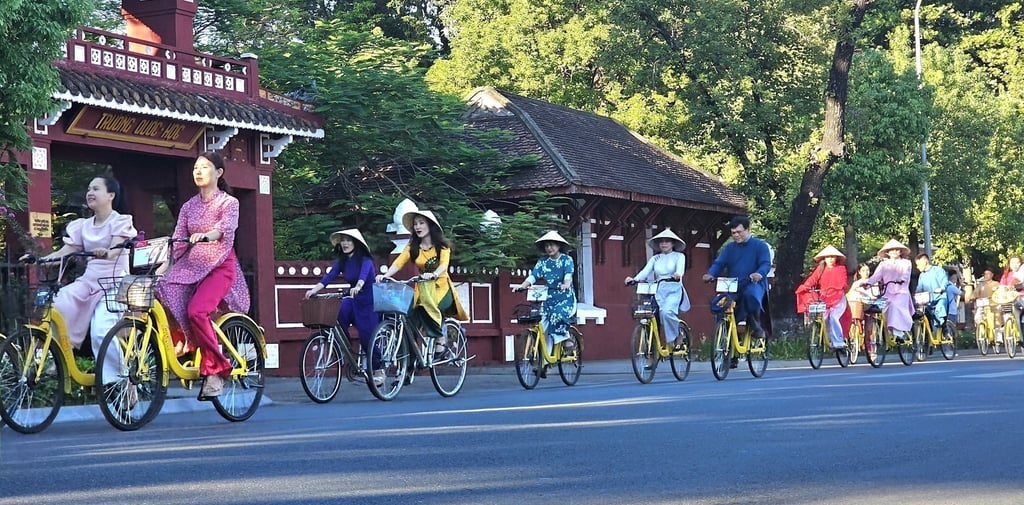
For the international traveler, the Áo Dài stands as the immediate, visible, and utterly unforgettable symbol of Vietnamese grace. It is an image deeply ingrained in the global consciousness: the flowing silk panels, the high, demure collar, and the subtle, fluid movement of fabric against the silhouette. Yet, to view the Áo Dài merely as clothing is to miss its profound, immense cultural weight. The Áo Dài is not static; it is a living manifesto—a deliberate, complex statement on history, gender, politics, and aesthetic philosophy that has been redefined, banned, revived, and ultimately embraced as the unwavering visual anchor of the Vietnamese soul. Its presence on the streets of Hà Nội or the canals of the Mekong Delta is a continuous, elegant declaration of national identity.
As specialists in Vietnamese heritage and profound cultural analysis at Vietnam Charm, we embark on an essential, detailed exploration to decode this national treasure. We will meticulously analyze the architectural philosophy of its design, its political function as a symbol of resilience and unity, the spiritual significance of its inherent modesty and movement, and the profound role it plays in articulating the singular elegance and inner strength of the Vietnamese woman. Understanding the Áo Dài is essential to grasping the aesthetic restraint, enduring strength, and historical continuity that define the nation.
1. The Philosophical Architecture: Simplicity, Modesty, and the Body as Canvas
The Áo Dài is arguably one of the world's most sophisticated garments because its ultimate power lies in what it conceals and how it manages the viewer's gaze, rather than what it explicitly reveals. Its design philosophy is deeply rooted in the classical principles of Vietnamese and East Asian aesthetics: modesty, structural minimalism, and the dynamic interplay between fluid movement and controlled stillness.
The garment consists of two essential and interdependent parts: the long tunic (Áo) with its high side slits, and the accompanying long, voluminous trousers (Quần). This two-part structure creates a unique visual narrative. The entire ensemble projects an image of uninterrupted flow, yet it is impeccably controlled by the tailoring. The high, mandarin collar (cổ áo) ensures spiritual and social modesty, elegantly framing the face while concealing the neck and chest, a traditional gesture of respect and reserve. The tunic itself is meticulously tailored to fit the body closely through the bust, waist, and shoulders, but then dramatically releases into two long, elegant panels that move and flow independently from the waist down to the ankle.
The true genius of the Áo Dài’s architecture lies in its defining feature: the side slits. These slits rise strategically high—sometimes well above the hip—allowing the garment to move freely and independently of the lower body. This creates a powerful paradoxical effect. While the garment covers the body almost entirely, the high slits, coupled with the flowing trousers underneath, allow the wearer to walk, bike, or move with total, unhindered grace. The fabric is thus a dynamic veil, simultaneously affirming traditional modesty and celebrating the female form in active, unconstrained motion. It transforms the body into a continuously moving, fluid sculpture, giving the dress its famed poetic and timeless quality.
2. The Evolution of Identity: From Courtly Ritual to Nationalist Symbol
The current, iconic form of the Áo Dài is the result of a dramatic, layered, and often politically charged evolution, reflecting centuries of dynastic shifts, social upheaval, and deliberate artistic intervention, making the dress a powerful, wearable historical document.
The Courtly Origins and Formal Mandate
The Áo Dài traces its most direct lineage to the Nguyễn Dynasty in the 18th century. It originated with court mandates issued to standardize dress codes across the newly unified territory. The earliest version, known as the Áo Ngũ Thân (Five-Paneled Tunic), was significantly looser, bulkier, and philosophically complex. The five panels symbolically represented the Five Elements (Ngũ Hành) and the four main cardinal directions plus the center, a direct affirmation of the cosmological and political order of the empire. This early form was purely ritualistic and hierarchical, emphasizing adherence to imperial structure rather than individual aesthetic.
The Modernist Transformation and French Synthesis
The crucial, defining transformation occurred in the 1930s, fueled by French colonial aesthetics and the burgeoning Vietnamese urban art scene. Key Vietnamese artists and designers, most notably Cát Tường (Le Mur), introduced radical Westernizing modifications. They eliminated the loose, hidden front panels, moved the line of buttons from the front to a subtle, diagonal line along the side (from neck to armpit), and, most importantly, drastically tightened the fit around the waist, bust, and shoulders. This artistic intervention transformed the Áo Dài from a loose, boxy ritual garment into the sleek, form-fitting dress celebrated today—a perfect synthesis of Eastern restraint and Western tailoring. This modernized, elegant form was quickly adopted by the urban elite of Hà Nội and Sài Gòn, swiftly becoming the immediate visual symbol of modern, sophisticated Vietnamese identity.
The Áo Dài as a Political Declaration
The Áo Dài’s history is intimately interwoven with periods of profound national struggle. During the intense ideological conflicts of the 20th century, the garment was often caught in the political crossfire, sometimes deemed "bourgeois" or "impractical" by revolutionary factions and temporarily replaced by simpler, more utilitarian clothing. Yet, the dress always made a powerful, inevitable return. Its unwavering resilience proves its power as an enduring, non-negotiable cultural anchor. The deliberate act of wearing the traditional dress, even when politically challenging, became a silent, non-violent declaration of Vietnamese identity, cultural continuity, and deep-seated national pride during periods of foreign domination or internal flux.
3. The Spiritual and Social Code: Silence, Color, and Grace
The Áo Dài functions as a powerful, unspoken social and spiritual code, communicating the wearer's status, intention, and mood through the carefully chosen fabric, color, and disciplined movement.
The Poetic Silence of Movement
The greatest aesthetic and philosophical achievement of the Áo Dài is its ability to communicate deep elegance through poetic silence and deliberate movement. The long, flowing panels are inherently anti-kinetic—they fundamentally resist fast, abrupt movement. The dress structurally forces the wearer to adopt a measured, gentle, and graceful pace. A woman in an Áo Dài cannot run, rush, or move clumsily without visually and physically disrupting the garment’s intended integrity. The dress thus mandates composure, inner stillness, and self-control, serving as a physical mechanism that enforces grace and discipline. This required restraint is a powerful expression of the traditional Vietnamese feminine ideal of công, dung, ngôn, hạnh (skills, appearance, speech, and virtue).
The Precise Language of Color and Occasion
The color choice of the Áo Dài is a direct, precise communication of the wearer's role, age, or immediate emotion within a social setting:
White: The color of absolute purity, simplicity, and spiritual innocence. It is famously and universally associated with high school and university students, symbolizing youth, hope, and an untainted future.
Red and Gold: These are the colors of ultimate celebration, joy, and prosperity, deemed essential for major rituals like Tết (Lunar New Year) and wedding ceremonies, signifying good fortune and happiness.
Pastel Tones (Light Pink, Blue, Green): Often chosen for daytime events and social gatherings, signaling gentle elegance and accessibility.
Darker/Muted Tones (Navy, Maroon, Deep Purple): Typically reserved for older, respected women, teachers, or solemn ritual occasions, symbolizing maturity, wisdom, and profound respect.
The fabric choice—from thick, elaborate brocade for winter or formal events to sheer, light silk for everyday wear—adds another complex layer to this nuanced visual code.
4. The Preservation Imperative: Tradition in a Modern World
The Áo Dài’s place in the 21st century is the ultimate testament to its cultural resilience, but its long-term preservation requires a careful negotiation between tradition, high fashion, and the practical demands of fast-paced, urban life.
The Challenge of Practicality and Adaptation
In an era dominated by motorbikes, dense office environments, and fast-paced urban living, the traditional, long Áo Dài can present serious structural challenges. The thin silk is vulnerable to damage, the length complicates getting on and off vehicles, and the white version is difficult to maintain in a busy city environment.
This challenge has spurred innovative artistic adaptations and continuous debate:
Áo Dài Cách Tân (Modernized Áo Dài): This modern interpretation often features shorter panels, boat or round necks (eliminating the high collar), and wider sleeves, making the garment significantly more comfortable, less restrictive, and practical for daily, casual use. While some cultural purists critique these structural changes as diluting tradition, the modernization ensures the form remains relevant and accessible to the younger, urban generation.
The Endurance of the Traditional: Despite the adaptations, the original, high-collared, long-sleeved version remains the undisputed, non-negotiable standard for weddings, professional gatherings, and all high-level cultural events, affirming the enduring power and superior elegance of its historical form.
The Global Recognition and the Future
The continuous, concerted national effort to promote the Áo Dài—through massive public fashion events, specialized design shows, and educational campaigns—reflects the nation’s deep-seated desire to have the dress formally recognized by the world. This effort is not just about promoting fashion; it is about formally recognizing the garment’s profound role as an Intangible Cultural Heritage, acknowledging its unique history, its structural complexity, and its role as a beautiful, enduring vessel for national memory and identity for generations to come. The Áo Dài stands as the singular, most elegant counter-argument to cultural homogenization.
5. Conclusion: The Masterpiece of Unspoken Grace
The Áo Dài is the ultimate cultural masterpiece of unspoken grace. It is a profound, eloquent statement on Vietnamese identity that demands patience, keen observation, and deep respect from the viewer. By meticulously analyzing its architectural genius—the beautiful balance between traditional modesty and dynamic movement—its political resilience across traumatic history, and its sophisticated language of color and posture, we truly begin to understand its enduring spiritual power. The dress is a living, continuous dialogue between the past and the present, ensuring that the elegant, unmistakable silhouette of the Áo Dài remains the singular, unwavering visual symbol of Vietnamese elegance, profound inner strength, and enduring cultural pride.
We are on social media
Vietnam Charm belongs to Vietpearl Travel., JSC
Contact:
Email: info@vietnamcharm.top
© 2026. by Vietnam Charm. All rights reserved
Travel license number: 01-827/2020
Refund Policy