Giảm giá hấp dẫn cho tour du lịch!



THE VALLEY OF IMPERIAL JUSTICE: AM TIÊN - THE TIGER’S BREATH AND THE PAGODA OF FORGIVENESS
A tale of two judgments: One is the brutal law of the 10th-century Emperor, the other is the serene mercy of the mountain’s silence. Discover the "Tuyệt Tình Cốc" of Vietnam, a hidden crater where history was written in blood and eventually washed away by prayer.
NINH BINHLOCAL EXPERIENCES
Tobin Nguyen
1/23/20264 phút đọc
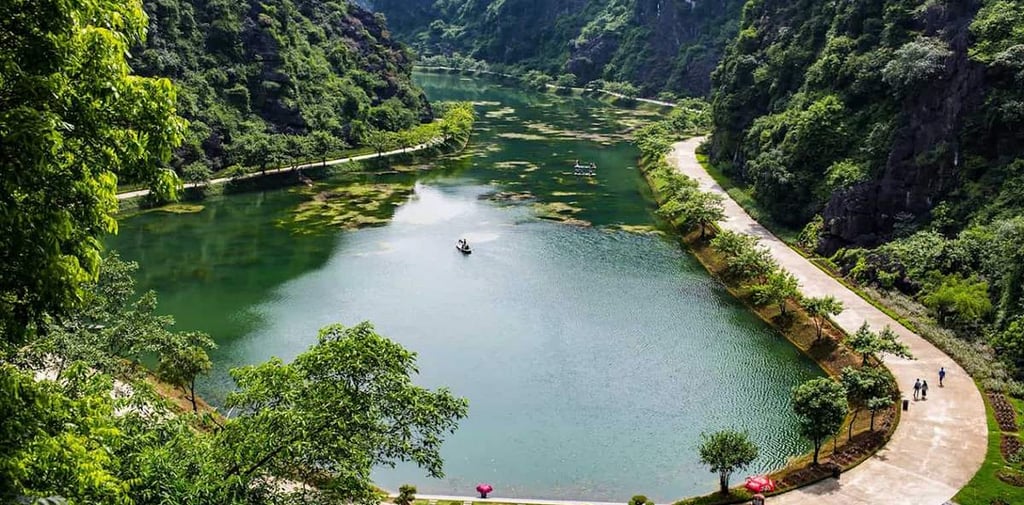
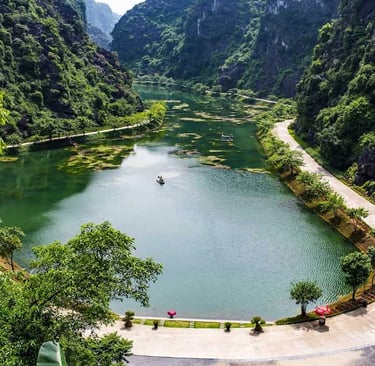
If you ask a young local for the most "Instagrammable" spot in Ninh Bình, they will point you to Tuyệt Tình Cốc (The Valley of Absolute Isolation). They come for the turquoise water and the perfect symmetry of the limestone walls. But if you dig beneath the "scenery," you find Am Tiên, a place with a history so dark and heavy it makes the mist in the valley feel like the breath of ghosts. This isn't just a valley; it is a natural amphitheater of imperial justice. In the 10th century, King Đinh Tiên Hoàng didn't just use these mountains for defense; he used them as a prison, a courtroom, and an execution ground.
1. The Tiger’s Crater: Justice in the 10th Century
The geography of Am Tiên is unique even for Ninh Bình. It is a "closed" valley—a deep, circular crater accessible only by a dark tunnel cut through the rock. In the early days of the Đinh Dynasty, this was the site of the Imperial Execution Grounds.
Legend has it that King Đinh, a man who believed in iron-fisted discipline to stabilize a new nation, kept a pit of fierce tigers in this valley. Criminals and traitors were thrown into the crater; those who survived the tigers were deemed innocent by the gods, while those who didn't served as a grim warning to any who would dare betray the crown. Standing at the edge of the emerald lake today, it’s hard to reconcile the peaceful beauty with the terrifying roars that must have once echoed off these vertical walls. It is a "Visual Slap" of duality: a paradise that was once a purgatory.
2. The Pagoda of the Queen: From Blood to Buddhism
High above the valley floor, perched in a cave that stares out over the water, is the Am Tiên Pagoda. The journey from the "Tiger Pit" to the pagoda is a symbolic climb from violence to peace. This is where, in the later years of the dynasty, the powerful Queen Mother Dương Vân Nga chose to spend her final days as a nun.
Inside the cave, the air is cool and smells of ancient stone and incense. This is where the woman who held the fate of two dynasties in her hands came to find silence. She traded her imperial robes for the simple brown cloth of a seeker, seeking forgiveness for the blood spilled in the name of the empire. When you stand in the mouth of the cave, looking down at the turquoise eye of the valley, you realize that Am Tiên is a monument to Transformation. It is where the "Warrior" of the 10th century became the "Saint" of the 11th.
3. The Turquoise Eye: The Mystery of the Water
The lake in the center of the valley, often called the Giải Oan (Exoneration) Lake, is famous for its preternatural blue color. The water is so clear that you can see the white limestone sand and the dark aquatic plants at the bottom, creating a depth of color that feels almost artificial.
The name "Giải Oan" tells the story of its soul. It was believed that the water had the power to wash away the "Oan" (the grievances or the heavy karma) of those who suffered in the valley. After the era of the tigers passed, the valley became a place of pilgrimage and prayer. The lake became a mirror—not just for the mountains, but for the conscience of a nation. Today, as you walk the perimeter of the water, the stillness is absolute. The mountains act as a soundproof barrier, locking the modern world out and keeping the 1,000-year-old secrets in.
4. The Gate of Silence: Entering the Void
To enter Am Tiên, you must pass through a long, narrow tunnel that pierces the mountain. This tunnel acts as a Sensory Filter. You leave the noise of the tour buses and the motorbikes behind, and for thirty seconds, you are in total darkness. When you emerge on the other side, the sudden explosion of green peaks and blue water is a shock to the system.
For the "Insider," Am Tiên is the best place to understand the Dual Heritage of Ninh Bình: the brutal reality of building a nation and the spiritual necessity of finding peace with that reality. It is a place of absolute isolation—not just from the world, but from time itself. It is the "End of the Road" for the restless soul, a valley where the tigers have long since vanished, leaving only the sound of the wind through the pines and the steady, quiet pulse of the turquoise water.
The Journalist's Epilogue:
Am Tiên is the conscience of Ninh Bình. It reminds us that every empire is built on hard choices and that even the most jagged history can be smoothed by the passage of time and prayer.
Next time you see a photo of the "Tuyệt Tình Cốc," remember the tigers and remember the Queen. Look past the turquoise beauty and see the "Shadow of Justice" that still lingers in the caves. You aren't just visiting a valley; you are standing in a place where a nation learned the difference between the power of the sword and the power of the soul.
We are on social media
Vietnam Charm belongs to Vietpearl Travel., JSC
Contact:
Email: info@vietnamcharm.top
© 2026. by Vietnam Charm. All rights reserved
Travel license number: 01-827/2020
Refund Policy