Giảm giá hấp dẫn cho tour du lịch!



TRÀNG AN: THE GHOST FORTRESS OF THE DUAL HERITAGE
A tale of two survivors: One is the limestone karst that stood against time, the other is an empire that vanished into the mountains to escape an invasion. Discover why this UNESCO Dual Heritage site—the only one of its kind in Southeast Asia—was a high-tech naval base a thousand years before the invention of the radar.
NINH BINHLOCAL EXPERIENCES
Tobin Nguyen
1/23/20264 phút đọc

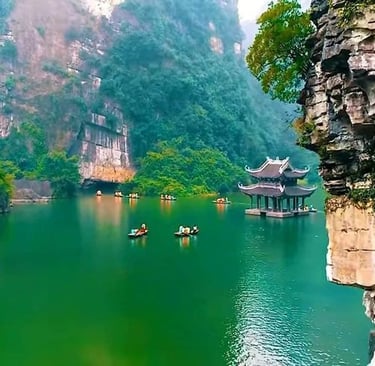
If you arrive at the Tràng An wharf at 10:00 AM, you will see a sea of orange life jackets and hear the rhythmic clatter of thousands of tourists. It looks like a theme park. But if you are with me, we are getting there when the sun is still a bruised purple behind the peaks. Because Tràng An isn’t a "scenic boat ride." It is a Labyrinth of War, a geological masterpiece that was hijacked by kings to become the most impenetrable naval fortress in Asian history.
This is the only place in the world where UNESCO recognized that you cannot separate the mountain from the man. This is the Dual Heritage: a 30,000-year-old dialogue between stone and soul.
I. The Imperial "Invisiblity Cloak"
In the 10th century, King Dinh Tien Hoang faced a nightmare: a massive Chinese invasion from the North. He didn't build a Great Wall. He did something smarter. He turned the earth itself into an Invisibility Cloak.
Tràng An is a system of "closed" valleys. In geography, they call them poljes—circular basins of water completely surrounded by vertical limestone walls. In military terms, they are Natural Killing Zones.
Imagine an invading fleet entering the first valley. They sail their heavy warships through a narrow opening, only to find the river suddenly disappears into a dark, low-hanging hole in a mountain. The boats are too big. The soldiers are terrified of the pitch-black tunnels. Meanwhile, the King’s scouts are watching every move from the peaks, and his elite guerrillas are paddling silent, low-profile sampans through secret "veins" in the mountain that no map has ever recorded. Tràng An wasn't a garden; it was a meat grinder for empires.
II. The Dark Anatomy: Tunnels That Breathe
We are skipping the tourist "Route 1." I’m taking you through the Dark Caves (Hang Tối).
When your boat enters the throat of the mountain, the temperature drops five degrees instantly. The world outside vanishes. The only sound is the rhythmic clack-clack of wooden oars hitting the limestone walls. These tunnels are the "lungs" of the dual heritage.
The "Insider" Detail: As we glide through, look up. You will see "chimneys"—natural vertical shafts that pierce the ceiling and lead all the way to the jungle-covered summits. These weren't just for light; they were for survival. They allowed the King’s soldiers to cook food and breathe fresh air while staying hidden deep inside the mountain for months during a siege.
Even deeper in time, archaeologists found prehistoric stone tools and shells in these very caves. Humans have lived in this labyrinth for 30,000 years. When the Kings arrived in 968 AD, they simply stepped into a house that nature had been building for millennia.
III. The Đền Trần: The Watchtower of the 12 Generals
To truly see the labyrinth, we have to climb. There is a sanctuary perched on a ridge called the Tran Temple (Đền Trần). Most tourists skip the 500 steps. They are making a mistake.
This temple is dedicated to the 12 Generals of the Tran Dynasty who guarded the southern gate of the water fortress. It is built entirely of stone—massive gray monoliths carved with dragons and clouds that have weathered 800 years of monsoon rains.
From this vantage point, the "scenery" becomes a Strategy. You see the circular basins of water, completely enclosed by 200-meter cliffs. It looks like a series of emerald eyes staring up at the sky. From here, you realize that if you were a sniper in the 10th century, you would be the master of this world. Nothing moves in Tràng An without being seen from these heights. You are standing on the "Bridge" of a stone battleship.
IV. The Feet That Rule the Water
The real soul of the Dual Heritage isn't the stone—it's the Rowers. These aren't just employees; they are the descendants of the people who have lived in these mountains since the time of the Kings.
Look at their legs. They row with their feet—a technique born out of sheer endurance, allowing them to row for 10 hours a day through the winding tunnels while keeping their hands free for other tasks. If you talk to them, they will tell you that the water in Tràng An is "alive."
They know which caves "whistle" before a storm and which temples are guarded by the "Shadow Kings." They are the living component of the UNESCO heritage. When the mist is heavy, watching a sampan emerge from a cave mouth is like watching a ghost ship returning from a forgotten century.
V. The Visual Slap: Beyond the Cinema
Yes, Hollywood came here to film Kong: Skull Island. They chose Tràng An because it is one of the few places on earth that looks Prehistoric. They brought helicopters and CGI, but they couldn't capture the real "special effect": the Absolute Silence.
Once you get past the first few caves and into the inner basins, the noise of the 21st century dies. You are left with the sound of water dripping from a stalactite—a sound that hasn't changed in 30,000 years. It is a visual slap of emerald green and limestone gray that forces your brain to recalibrate.
The Journalist's Epilogue:
Tràng An is the ultimate Dual Heritage because it is a place where nature provided the fortress and man provided the courage. It is not a place you "visit"; it is a place you "navigate."
Next time you see a postcard of these mountains, don't just think "pretty." Think "Fortress." Think about the thousands of soldiers who sat in the pitch black of those caves, waiting for the signal to defend a kingdom that refused to be found. Tràng An is a reminder that the most beautiful places are often the ones that were most fiercely protected by both God and King.
We are on social media
Vietnam Charm belongs to Vietpearl Travel., JSC
Contact:
Email: info@vietnamcharm.top
© 2026. by Vietnam Charm. All rights reserved
Travel license number: 01-827/2020
Refund Policy