Giảm giá hấp dẫn cho tour du lịch!


VAN LONG WETLAND: THE SILENT MIRROR OF THE TUXEDOED KINGS
A tale of two reflections: One is the shattered mirror of tourist crowds, the other is the flawless glass of a forgotten wetland. Discover the world’s rarest primate and why silence is the most expensive luxury in the "Vanishing Marsh" of Van Long.
NINH BINHLOCAL EXPERIENCES
Tobin Nguyen
1/23/20264 phút đọc
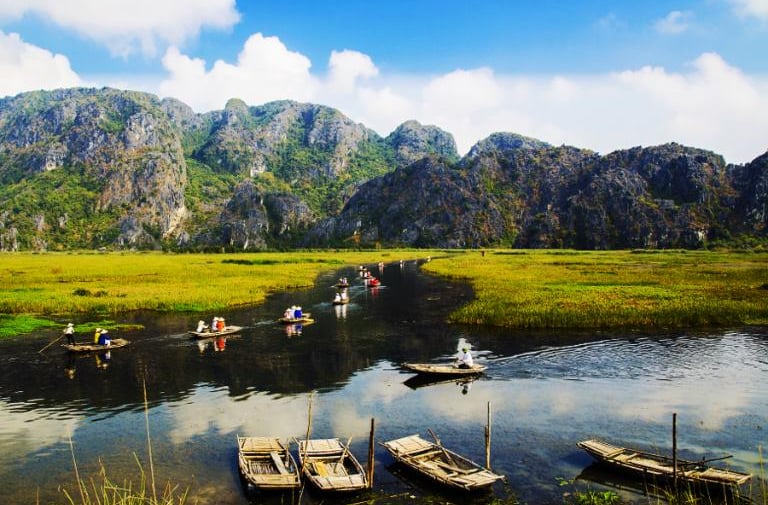
If the emerald labyrinth of Tràng An is a roaring epic of war and kings, then Van Long Wetland is a whispered poem, written in the language of shadows and water. In the modern world of travel, we often chase "hidden gems" only to find them polished and crowded, but Van Long remains something different. It is a sanctuary of the forgotten, a place where the 21st century seems to lose its breath and simply stop at the edge of the reeds. While the rest of Ninh Binh struggles under the weight of its own fame, Van Long has stayed in the wings, offering no motorboats, no megaphones, and no Hollywood movie sets—only the rhythmic, hypnotic slice of a wooden oar through water so still it looks like liquid obsidian.
1. The Mirror of the Gods: Why Van Long is Ninh Binh’s Hidden Sanctuary
The first thing that strikes you at Van Long isn't the jagged height of the limestone peaks, but the terrifying perfection of the reflection. The water here is shallow, protected from the wind by a massive natural wall of stone, creating a surface that becomes a flawless black mirror. The locals call these "Floating Mountains" because, on a clear afternoon, the horizon disappears entirely; you cannot tell where the weathered rock ends and its twin in the water begins.
As a journalist, I have seen many famous "mirrors" across the globe, but Van Long’s is unique because it is rooted in darkness. The bottom of the marsh is carpeted in thick, dark aquatic grass, giving the water an ink-like quality that makes the white herons standing among the reeds look like delicate brushstrokes on an ancient silk painting. This isn't just a scenic spot; it is the largest wetland nature reserve in the Red River Delta, a 3,000-hectare ecosystem where nature still holds the ultimate veto power over human noise.
2. Searching for the Delacour’s Langur: The "Monks in Tuxedos"
But we are not drifting through this silent mirror just for the scenery; we are here to find a ghost. Van Long is the final fortress of the Delacour’s Langur (Trachypithecus delacouri), one of the top 25 most endangered primates on the planet. Often called "monks in tuxedos" due to their striking black fur and white "pants," these creatures are the true Shadow Kings of the marsh. Unlike their cousins in the jungle, these langurs have adapted to a life on the vertical faces of the limestone cliffs.
To find them, you must learn to navigate the silence. As your boat glides under the towering "Meo Cao" (Cat Scratch) cliff, you have to stop looking at the water and start scanning the 90-degree stone walls. They move with an impossible, gravity-defying grace, and to see a family of them sitting on a limestone ledge as the light turns to amber is a visual shock that reminds you how fragile this entire ecosystem really is. There are only about 200 of them left in the world, watching us from their high perches with a quiet, ancient indifference that puts our modern anxieties into perspective.
3. An Accidental Masterpiece: The Human History of the Vanishing Marsh
The marsh itself is an unintended masterpiece of human and natural engineering. Formed by a massive dike system built in the 1960s to protect surrounding villages from the monsoon floods of the Day River, Van Long accidentally became a magnet for life. The dike trapped the water against the mountains, creating a unique wetland that now serves as a "living airport" for migratory birds.
In the winter months, the sky here is a chaotic, beautiful swirl of thousands of white storks and rare teals. Because the boats are small and hand-paddled by local villagers—mostly women who have spent their entire lives navigating these reeds—you can get close enough to hear the soft whistle of a heron’s wings as it takes flight. This is the ultimate antidote to over-tourism; here, you are no longer a consumer of a "view," but a quiet witness to a cycle of life that has thrived since the dike first transformed the landscape.
4. Hang Bóng: Navigating the Shadows of History
Just when the open space of the marsh begins to feel infinite, your boatman will steer the prow toward a dark, jagged crack in the mountain base known as Hang Bóng, or the Shadow Cave. This is where the story of the marsh grows darker and more intimate. The tunnel is over a hundred meters long, and as you enter, the ceiling drops so low that you are forced to lie flat on the bottom of the boat, feeling the damp breath of the mountain on your face.
The wide silence of the marsh is replaced by the rhythmic drip... drip... of limestone water and the echoing splash of the oars. These caves were the natural bunkers of history, where local families hid their grain and their children during the long years of war. Emerging from that claustrophobic dark back into the blinding turquoise light of the marsh is a sensory rebirth, a reminder that even in this peaceful wetland, every shadow has a history of survival. It is in these dark corners that the "dual heritage" of Ninh Binh—the marriage of geology and human endurance—feels most tangible.
The Journalist's Epilogue:
Van Long Wetland is the "Vanishing Marsh" not because the water is receding, but because the silence it represents is becoming extinct in our noisy world. It is a place that demands you lower your voice, put down your camera for a moment, and simply breathe. There are no souvenir stalls or overpriced cafes here—only the luxury of nothingness. It is a reminder that the most powerful stories aren't the ones shouted through a megaphone at a crowded wharf, but the ones whispered by the wind as it moves through the tall grass, carried by the ghosts of the tuxedoed kings on the cliffs above.
We are on social media
Vietnam Charm belongs to Vietpearl Travel., JSC
Contact:
Email: info@vietnamcharm.top
© 2026. by Vietnam Charm. All rights reserved
Travel license number: 01-827/2020
Refund Policy