Giảm giá hấp dẫn cho tour du lịch!


WHERE THE SACRED AND THE SENSORY COLLIDE — A VIVID JOURNEY INTO ECSTASY, ELABORATE COSTUMES, AND THE MYSTICAL ART OF SPIRITUAL POSSESSION.
More than performance: exploring Văn Hóa Hầu Đồng (Spirit Mediumship) as Việt Nam’s ultimate dynamic spiritual technology, analyzing its profound function as a direct, ecstatic conduit for divine communion, its architectural complexity of costume and music, and its embodiment of spiritual release, resilience, and personal healing.
VIETNAMESE CULTURETHE COSMIC TOLERANCELOCAL EXPERIENCES
Tobin Nguyen
11/8/20255 phút đọc
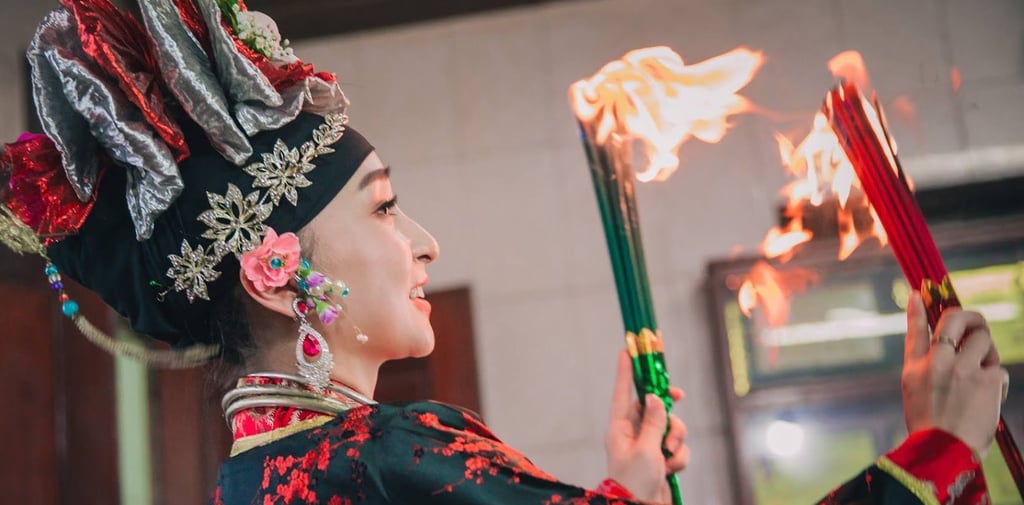
For the international ethnographer, the scholar of ritual performance, and the seeker of the nation’s raw, dynamic spiritual energy, Hầu Đồng (Spirit Mediumship) is not a mere cultural curiosity; it is the nation’s most intense, palpable, and emotionally consuming spiritual spectacle—the single, non-negotiable ritual that transforms the temple hall (Điện) into a vibrant, moving court where the veil between the human world and the divine court of the Mẫu (Mother Goddess) is temporarily, miraculously dissolved. Hầu Đồng asserts an ultimate, profound truth: the divine is accessible, empathetic, and requires physical, ecstatic communion to impart its blessings, guidance, and energy. The entire ritual is a high-stakes, dramatic, and disciplined process of spiritual surrender, where the human body becomes the temporary, revered vessel for ancestral and divine power.
As specialists in Vietnamese heritage and profound cultural analysis at Vietnam Charm, we embark on an essential, detailed exploration to decode this lyrical, rhythmic spiritual philosophy. We will meticulously analyze the spiritual mandate that dictates the ritual (the descent of the Thánh), the architectural genius of costume and music (Chầu Văn) in facilitating spiritual transformation, the psychological function of ecstasy and catharsis for both the medium and the audience, and the profound way this ritual articulates the core national values of spiritual accessibility, compassionate intervention, and the enduring resilience of the possessed body. Understanding Hầu Đồng is essential to grasping the emotional heart and the dynamic, passionate energy that underpins the Đạo Mẫu system.
1. The Spiritual Mandate: The Descent of the Thánh and the Power of Mediation
The foundation of the Hầu Đồng Ritual is an absolute spiritual mandate: the belief that specific deities and Sages from the vast, hierarchical pantheon of Đạo Mẫu possess the capacity and the desire to descend (giáng đồng) into a human vessel (the Thanh Đồng/Medium) to interact directly with their human children. The medium is the essential mediator between the cosmos and the community.
The Purpose of Descent: The descent of the Thánh (Holy Ones) is driven by two primary, compassionate purposes:
Imparting Lộc (Blessings): The deity provides tangible spiritual blessings—often rice wine, money, fabric, or fruit (lộc)—to the audience, symbolizing divine generosity, protection, and the guarantee of prosperity for the coming year.
Offering Guidance and Healing: The spirits provide counsel, comfort, and direct, personal guidance to the supplicants regarding family, health, and livelihood. The spirits' intervention is viewed as highly powerful, immediate, and effective, satisfying the spiritual pragmatism of the populace.
The ritual transforms the spiritual relationship from a distant, abstract concept into a palpable, sensory, and emotionally intense reality. The ability to witness the divine, to speak to the Sages, and to receive blessings directly reinforces the faithful's absolute conviction in the power and benevolence of the Mẫu pantheon. The performance is the ultimate affirmation of faith.
2. The Architectural Genius: Music, Costume, and the Transformation of Form
The spiritual efficacy of Hầu Đồng is entirely reliant on the architectural genius of its multimedia structure—the meticulous, rapid integration of music (Chầu Văn) and costume to facilitate the physical and spiritual transformation of the medium.
Chầu Văn (The Sacred Soundtrack): The Chầu Văn music is the absolute, non-negotiable soundtrack and the energetic engine of the ritual. This traditional, highly specialized folk music—featuring the đàn nguyệt (two-stringed lute), trống (drum), and phách (wooden clappers)—is characterized by its fluid, hypnotic, and emotionally evocative rhythm. The music's rhythm and lyrics are meticulously tailored to the specific phẩm (form/style) of the descending spirit, acting as a powerful energetic conductor that calls the spirit down, sustains its presence, and dictates the pace and mood of the performance. The sound itself is a command to the spiritual realm.
The Costume as Spiritual Cloak: The costumes and accessories are the ultimate tool for physical transformation and dramatic recognition. As each spirit descends, the medium is rapidly, meticulously clothed in the specific, elaborate costume corresponding to the deity's rank, color (Red for Heaven, Green for Mountain, White for Water), and historical era. This rapid change of form—often performed dozens of times in a single ritual—is the visible, external proof that the human vessel has been superseded by the divine presence. The costume is not merely dress; it is the spiritual cloak that allows the audience to immediately recognize and revere the divine character, ensuring the integrity of the ritual performance.
The combination of the flowing music, the dramatic color changes, and the intense energy transforms the temple hall into a living, moving spiritual court, blurring the line between worship, theater, and direct divine experience.
3. The Psychological Function: Ecstasy, Catharsis, and the Release of Self
Hầu Đồng serves a profound psychological function for both the medium and the audience, providing a disciplined, sacred arena for ecstasy, emotional catharsis, and the temporary release of the individual self into the collective spiritual current.
Ecstasy and Possession: For the Thanh Đồng (Medium), the ritual requires a profound, disciplined act of spiritual surrender—the controlled, conscious yielding of their own personality and will to the descending spirit. The subsequent state of ecstasy (often manifesting as intense energy, dancing, trance-like movement, or highly stylized actions) is the visible, physiological evidence of the divine possession. This temporary loss of self is spiritually purifying, providing a moment of profound psychological release from the burdens of their own individual identity and karma.
Communal Catharsis: For the audience (con nhang đệ tử), the ritual provides a powerful source of collective emotional catharsis and validation. Witnessing the vibrant, selfless performance, receiving blessings, and directly speaking to the embodied spirits allows the audience to release accumulated stress, fear, and personal anxiety. The shared energy, the sound of the Chầu Văn, and the visible proof of the divine's accessibility reinforce a collective psychological sense of safety, hope, and belonging. The ritual is a temporary, intense emotional cleansing for the entire community.
4. The Sociological Code: Hierarchy, Gender, and the Code of Prophecy
The Hầu Đồng Ritual operates under a complex sociological code, reinforcing the fluid, spiritual hierarchy of the pantheon, providing a space for feminine spiritual authority, and serving as a mechanism for communal prophecy.
Hierarchy in Motion: The sequence of the spirit descents is rigidly hierarchical, moving from the highest deities (the Mẫu and the Quan/Mandarins) down to the more playful, localized spirits (the Cậu/Young Sages). This sequence ritually reinforces the cosmic and spiritual order of the pantheon, providing a clear visual and emotional map of the spiritual chain of command. The audience's disciplined adherence to this sequence is a social affirmation of their belief in the system's integrity.
Feminine Authority and Gender Fluidity: The ritual is a powerful statement of spiritual gender equality. While the supreme authority is the feminine Mẫu, the Mediums themselves (male and female) frequently embody powerful male Sages, Generals, and Warriors (Quan Lớn). This gender fluidity in performance asserts a core truth of Đạo Mẫu: spiritual power transcends rigid gender binaries, and the most effective channel for the divine may be the one most spiritually prepared, regardless of their physical body. This offers a powerful, alternative vision of authority within a society historically defined by patriarchal structures.
5. Conclusion: The Permanent Testament to Dynamic Faith
Văn Hóa Hầu Đồng (Spirit Mediumship) is the ultimate, enduring, and dynamic testament to the Vietnamese soul’s commitment to spiritual accessibility, communal healing, and the power of ecstatic faith. It is a ritual that transforms the disciplined body into the sacred vessel of the divine court. By analyzing the spiritual mandate for the deity's descent, the architectural genius of the Chầu Văn and costume as conduits for transformation, the psychological function of ecstasy and communal catharsis, and the sociological code that reinforces hierarchy and spiritual gender fluidity, the observer gains access to a core, luminous truth: Hầu Đồng is far more than performance. It is the permanent, unwavering declaration of dynamic faith—a powerful, sensory assertion that asserts the cultural value of spiritual empathy, collective resilience, and the belief that the purest, most immediate form of divine power is found in the disciplined, beautiful, and emotionally intense surrender of the human heart.
We are on social media
Vietnam Charm belongs to Vietpearl Travel., JSC
Contact:
Email: info@vietnamcharm.top
© 2026. by Vietnam Charm. All rights reserved
Travel license number: 01-827/2020
Refund Policy