Giảm giá hấp dẫn cho tour du lịch!

WORLD HERITAGE SITE: Mỹ Sơn Sanctuary — Unearthing the Mysticism, Rituals, and Unsolved Engineering of the Champa Kingdom
The sacred valley of the Chăm: decoding the Hindu influence, the powerful legacy of the temples, and the enduring mystery of the ancient, mortar-less brick architecture.
WORLD HERITAGESHORE EXCURSION
Tobin Nguyen
11/5/20257 phút đọc
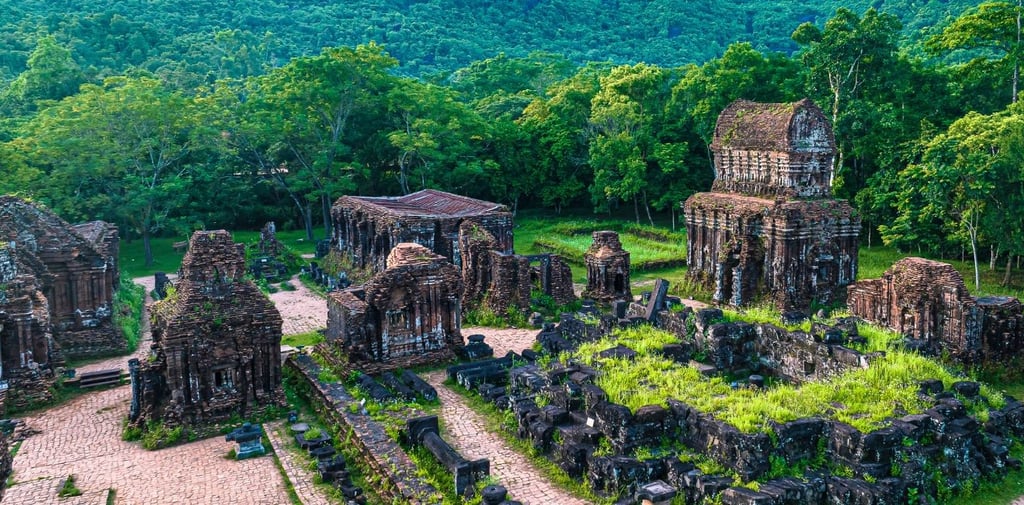
For historians of Southeast Asian empires, archaeologists, and travelers seeking the profound echo of a vanished civilization, Mỹ Sơn Sanctuary stands as a haunting, unparalleled testament. Recognized by UNESCO as a World Heritage Site in 1999, Mỹ Sơn is far more than a collection of ruined temples; it is the spiritual and political heart of the ancient Champa Kingdom (4th – 13th centuries)—a civilization that once dominated the coastal plains of Central Việt Nam. To walk into this secluded valley, nestled between green mountains and cut by a sacred stream, is to enter a meditative space steeped in Hindu cosmology, architectural genius, and the enduring mystery of a culture that prioritized devotion and artistry over defensive might. The sense of solitude here is overwhelming, compelling the visitor to contemplate the slow erosion of time.
As specialists at Vietnam Charm, we embark on an essential, detailed exploration to decode this sacred valley. We will meticulously analyze the Hindu cosmology that governed its construction and layout, the intricate architectural language of the Chăm towers (Kalan), the profound, still unsolved engineering mystery of the brick construction, and the essential strategies required to grasp the depth of its solemn, quiet grandeur. Understanding Mỹ Sơn is to understand the powerful, spiritual dialogue between the Chăm people, their Hindu deities, and the very structure of the cosmos itself.
I. Cosmology and Geography: The Sacred Valley of Shiva
Mỹ Sơn was the foremost religious and political center of the Champa Kingdom for nearly a thousand years. Its location was not arbitrary; it was a deliberate, geographically dictated choice that reflected the deepest spiritual beliefs and political requirements of the Chăm people, marrying the earthly domain with the heavens.
The Geographical and Spiritual Mandate
The sanctuary is strategically situated in a natural basin, a secluded valley surrounded by a protective ring of mountains. This natural isolation was a key requirement for a sacred site, ensuring purity and devotion. The Chăm revered the stream that cuts through the valley, naming it Thánh Thủy (Sacred Water), which spiritually connected the complex to the coast and the sea, vital for their maritime economy. The entire complex, and the surrounding mountains, were intended to be a terrestrial representation of Mount Meru—the mythical, golden mountain that is the central axis of the universe in Hindu, Jain, and Buddhist cosmology. Mount Meru is believed to be the dwelling place of the deities. By building Mỹ Sơn, the Chăm symbolically established a direct, powerful spiritual link between their human capital (Simhapura, nearby) and the highest Hindu heavens, thereby legitimizing the king's rule.
The worship at Mỹ Sơn was primarily dedicated to Bhadresvara—a syncretic deity that profoundly combined the local ruling monarch, King Bhadravarman, with the supreme Hindu god, Shiva (Siva), the powerful destroyer and transformer of the universe. Shiva, often manifested as the sacred phallic symbol Lingam, was housed in the central towers, symbolizing the spiritual energy, fertility, and regenerative power of the kingdom, ensuring the continuity of the dynasty.
The Architectural Chronology of Devotion
The temples at Mỹ Sơn were not constructed in a single effort. They were built by successive Chăm kings over nearly a millennium, each new group of temples representing a new dynasty, a political peace treaty, or a grand ceremonial dedication. This continuous construction demonstrates the enduring political and spiritual importance of the valley. Archaeologists today group the temples into clusters—labeled A, B, C, D, etc.—which allows historians and visitors to trace the architectural and artistic evolution of the Champa Kingdom with precision, revealing subtle but significant shifts in style, construction technique, and decorative focus over time, from the early, robust Mỹ Sơn E1 style (4th century) to the later, highly decorative Bình Định style (11th-13th centuries). This chronological layering makes the valley a unique, multi-period architectural library.
II. The Architecture of the Chăm: Decoding the Kalan Structure
The primary and most enduring architectural structure at Mỹ Sơn is the Kalan (the tower-temple). This unique structural design encapsulates Chăm artistry, engineering prowess, and religious purpose, acting as the physical conduit between the human and divine worlds.
The Function and Form of the Kalan
A typical Chăm temple complex at Mỹ Sơn was meticulously arranged, featuring three distinct, interdependent structures. The most imposing was The Kalan (The Tower) itself. This was the largest, central structure—a square-based brick tower, often tapering towards the top with high, false tiers. The Kalan was the consecrated dwelling place of the deity, typically housing the Shiva Lingam or a statue of the primary god, and was the most sacred area, accessible only to priests and royalty. The secondary structure was The Mandapa (The Waiting Hall), a rectangular, lighter structure located directly in front of the Kalan. This hall served as a vestibule or a place for worshippers and priests to gather, prepare for rituals, and conduct preliminary sacrifices before approaching the Kalan. Finally, there was The Kosagrha (The Fire House/Storehouse), a smaller, long structure used primarily for storing the essential sacrificial items, religious vestments, or sometimes as a dedicated repository for the ritual fire—an important, purifying element in Hindu ceremony. This tripartite arrangement ensured a ritualistic flow for worship.
The Narrative Language of the Decorations
The exteriors of the Kalan towers are not merely decorated; they are covered in highly detailed, intricate carvings that serve as a pictorial narrative of Hindu cosmology and mythology. The decorative sculptures were created using two primary methods: they were either carved directly onto the brick walls or cast from terracotta and then embedded, or meticulously carved from sandstone blocks and then attached to the facade. These elaborate sculptures depicted key mythological figures, including the dancing celestial nymphs, the Apsaras; the protective, elephant-headed god Ganesha; and complex scenes from the epic Hindu stories of the Ramayana and the Mahabharata. These carvings functioned as a constant, vivid visual reminder of the divine world and the cosmological order that the king was mandated to uphold, educating the populace in the sacred texts.
III. The Enduring Mystery: Mortar-less Brick Engineering and Lost Artistry
The most compelling and still largely unsolved mystery of Mỹ Sơn is the highly advanced, utterly unique brick construction technique used by the Chăm builders—a sophisticated technique that has allowed the towers to withstand centuries of intense tropical climate, relentless erosion, and even modern warfare. This engineering feat challenges contemporary knowledge of ancient building materials.
The Unsolved Brick-Joining Puzzle
The Chăm towers are built predominantly from small, light, red bricks, meticulously laid with minimal visible spacing. The central puzzle that confounds engineers and restorers remains: how were the bricks joined so seamlessly, and how were the highly ornate carvings executed without damaging the structure? One leading theory suggests that the bricks were laid tightly while they were still soft or semi-fired. An unknown natural resin or a sophisticated, thin organic adhesive—perhaps derived from local jungle flora—was used to bind them. Then, the entire structure may have been intensely fired in situ (on the spot) at extremely high temperatures, fusing the bricks and the adhesive.
The Carving Enigma and Structural Resilience
Another widely accepted theory, especially regarding the intricate decorative surfaces, suggests that the Chăm builders meticulously erected the entire wall structure first using an unknown binding agent. Then, they carved the intricate designs directly into the soft brick surface after the structure was complete, before the bricks fully hardened. This method, if true, required superhuman skill, immense artistry, and an intimate, perfect understanding of the material's working properties. This unique engineering process gave the structures extraordinary resilience. The seamless, tightly-fit nature of the walls makes them highly resistant to water infiltration and erosion—the very forces that destroy modern concrete and mortar. The temples have miraculously endured centuries of intense, humid monsoon rains and tropical heat, surviving severe damage—particularly from aerial bombings during the conflicts of the 20th century—due to the incredible structural integrity of the Chăm method. The preservation efforts at Mỹ Sơn today rely heavily on attempting to understand and replicate this lost, sophisticated technique—a powerful testament to the Chăm’s forgotten architectural and material genius.
IV. From Discovery to Sanctuary: The Modern History and Conservation
The Mỹ Sơn Sanctuary lay largely forgotten, consumed by the dense, surrounding jungle, until the late 19th century. Its rediscovery set the stage for modern study, intense conservation efforts, and the challenges of historical interpretation.
The French Discovery and Cataloging
The ruins were brought back into historical consciousness in 1898 when the French scholar Camille Paris first stumbled upon them. Subsequent critical archaeological efforts, notably by Henri Parmentier, meticulously cataloged the sites, identifying the numerous temple groupings (A, B, C, etc.) and linking them chronologically to the various Champa dynasties. This vital, foundational groundwork established Mỹ Sơn’s irrefutable place as a global archaeological treasure.
The Challenge of Conservation and Reconstruction
The sanctuary faces immense conservation challenges today, primarily due to the inherent fragility of the ancient brickwork when exposed to the unrelenting tropical climate. The site suffers from continuous decay due to water infiltration and erosion. Furthermore, many key temples (especially the central Group A) were severely damaged in 1969. Reconstruction requires innovative, painstaking efforts to find materials and techniques that mimic the Chăm's original sophisticated mortar-less method without causing further irreversible damage to the surviving structures. International cooperation, including experts from Italy, Poland, and Japan, has been crucial in stabilizing the remaining towers and preserving the site’s fragile integrity, ensuring its long-term survival as a vital World Heritage Site and preventing the complete loss of this unique architectural knowledge.
V. Conclusion: The Grandeur of Devotion and Lost Art
Mỹ Sơn Sanctuary is a profound, meditative narrative carved in brick and stone. It is not a place of overwhelming physical scale, but one of deep, intense spiritual focus—a concentrated axis mundi where the Chăm kings sought to establish direct, lasting communication with Lord Shiva and the Hindu cosmos. The haunting ruins, the silent Lingams, and the enduring mystery of the mortar-less brickwork offer the reflective traveler an unparalleled opportunity to connect with the artistry, devotion, and remarkable lost engineering genius of the Champa Kingdom. This essential World Heritage Site is a powerful, irreplaceable reminder that true civilization is often measured not by its military power or economic might, but by the profound elegance of its spiritual and architectural ambition.
We are on social media
Vietnam Charm belongs to Vietpearl Travel., JSC
Contact:
Email: info@vietnamcharm.top
© 2026. by Vietnam Charm. All rights reserved
Travel license number: 01-827/2020
Refund Policy