Giảm giá hấp dẫn cho tour du lịch!



WORLD HERITAGE SITE: The Limestone Symphony — Tràng An Heritage
Where Nature, History, and the Ancient Capital of Hoa Lư Merge: decoding Việt Nam’s only Mixed World Heritage Site, exploring the profound relationship between its stunning flooded karsts and a thousand years of cultural continuity.
WORLD HERITAGESHORE EXCURSION
Tobin Nguyen
11/10/20256 phút đọc

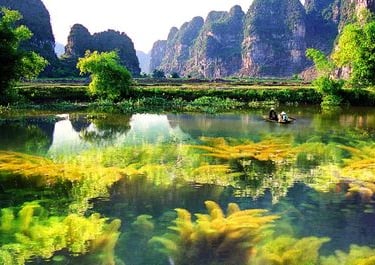
For scholars of both natural history and political formation, the Tràng An Landscape Complex in Ninh Bình province offers an unparalleled, living historical narrative. Recognized by UNESCO as a Mixed World Heritage Site (encompassing both Cultural and Natural values) in 2014—the first and, so far, only one in Việt Nam—Tràng An is far more than just a beautiful tourist destination. It is a vast, open-air testament to the symbiotic relationship between Earth’s immense geological forces and humanity’s strategic drive for civilization. To drift silently on a small boat through its serpentine flooded rice paddies and dark, winding caves is to trace the precise geographical context that allowed the formation and ultimate solidification of the independent Vietnamese state.
As specialists in Vietnamese heritage, geology, and cultural continuity at Vietnam Charm, we embark on an essential, detailed analysis to decode this Limestone Symphony. We will meticulously examine the unique geological process that distinguishes Tràng An from other karst regions like Ha Long Bay, the profound political and military role it played as the Ancient Capital of Hoa Lư, the concept of karst-based civilization, and the strategies required to grasp the enduring, deep, dual significance of this site. Understanding Tràng An is essential to understanding the moment Việt Nam’s sovereignty was physically solidified on a strategic, geological foundation.
I. The Natural Foundation: A Unique Inland Karst Formation and Geological History
The natural value of Tràng An lies in its spectacular, unique beauty and its distinct, scientifically important geological origin. Its landscape is an inland, submerged karst system, providing a unique scientific case study of geological transformation.
1. The Geological Chronicle: Submerged Towers and Water Dynamics
The limestone bedrock of Tràng An, dating back over 250 million years (from the Paleozoic era), underwent the same colossal tectonic uplift and subsequent chemical dissolution (karstification) that characterized Central and Northern Việt Nam. However, its interaction with the sea provides the key distinction:
Cycles of Sea Level Change: Tràng An experienced several major cycles of marine transgression (sea level rise, inundating the valleys) and regression (sea level fall). Unlike Ha Long, where the valleys were permanently flooded by the sea, Tràng An’s karst towers rise from a lowland, continuously flooded plain composed of intricate river systems, streams, and rice paddies. This creates a unique "terrestrial Ha Long" effect, where the sea’s influence remains visible in the erosion lines, but the current water is fresh or brackish.
The River’s Embrace (Sông Sào Khê): The Sào Khê River and its intricate network of tributaries are the lifeblood and the ongoing sculptor of Tràng An. These rivers continuously carve through the limestone, creating hundreds of interconnected, submerged caves (hang), which function as natural tunnels and waterways. The crucial presence of fresh water, rather than salt water, dictated the local ecology, agriculture, and the feasibility of human settlement and defense.
2. Speleology and Sedimentation
The caves of Tràng An are scientifically invaluable. They contain evidence of the cyclical sea level changes, visible in the distinct erosion lines and the sedimentation layers. The lower, permanently submerged sections of the caves represent the Phreatic Zone, while the upper sections show Vadose Zone characteristics. The stalactites and stalagmites here tell a story of humidity and consistent water flow over millennia. The geological seclusion of the karst towers also contributed to the high concentration of endemic flora and fauna species found within the protected park boundaries.
II. The Cultural Foundation: Hoa Lư, The Capital of Sovereignty
The profound cultural and political significance of Tràng An is inextricably linked to the establishment of the Ancient Capital of Hoa Lư, which used this unique, defensible geography to solidify the independence of the Vietnamese state.
1. The Crucible of Đại Việt (968–1010 AD)
The critical political moment occurred in 968 AD when Đinh Bộ Lĩnh reunified the fragmented country (after the " loạn 12 sứ quân" - chaos of 12 warlords) and established the Đinh Dynasty, naming the nation Đại Cồ Việt. He chose the secluded, naturally fortified area of Hoa Lư as his capital:
Natural Fortress and Defense: The towering, circular limestone mountains provided ready-made, insurmountable walls against both internal dissent and external invasion. The numerous caves served as natural, secure barracks, storage depots, and supply points. The complex water network provided essential transportation and communication links while acting as a natural, impassable moat against large organized armies. This geography gave the fledgling state a massive military advantage.
The Symbol of Independence: By establishing the capital here, deliberately away from the political and cultural centers associated with a millennium of Chinese rule (like Đại La/Hà Nội), Đinh Bộ Lĩnh signaled a decisive, powerful break with the past and asserted the fully independent sovereignty of the Vietnamese state. Hoa Lư was the strategic crucible where the independent Vietnamese nation was forged.
2. The Great Move and Lý Thái Tổ’s Strategic Vision
The capital was short-lived, lasting only 42 years (under the Đinh and the early Lê Dynasties) before being moved to Thăng Long/Hà Nội in 1010 AD by Lý Thái Tổ. The reason for the move, despite Hoa Lư’s excellent defense, was rooted in a visionary political strategy:
Political Centralization: While Hoa Lư was secure, its defensive geography made it too secluded and difficult to administer a rapidly expanding nation. Lý Thái Tổ needed a capital that was also a center for trade, culture, and easy administration of the entire territory.
The Philosophical Shift: Moving to Thăng Long (the Ascending Dragon) was a philosophical shift from a capital built for defense and survival (Hoa Lư/Tràng An) to a capital built for growth and prosperity (Thăng Long). The geological protection of Tràng An was sacrificed for the logistical and political centrality of the Red River Delta.
III. The Symbiotic Symphony: Culture Intertwined with Nature
Tràng An’s designation as a Mixed Heritage Site recognizes the rare instance where natural beauty and cultural history are not merely adjacent, but are profoundly and symbiotically intertwined. The history of the early Vietnamese state could not have existed without the protective, complex geology of the area.
1. Archaeological Evidence and Human Habitation
The numerous caves within the complex are not just geological features; they are highly valuable archaeological sites. Extensive excavations have revealed evidence of continuous human occupation dating back over 30,000 years (from the late Paleolithic and Neolithic eras), showing that prehistoric humans lived, hunted, and thrived within the shelter of the limestone caverns. This long-term human use connects the ancient history of hunting and gathering populations with the later history of imperial defense, demonstrating a continuous, profound human-geology relationship. The limestone provided essential shelter, defense, and sustenance across millennia.
2. The Cultural Landscape of Rice and Water
The modern landscape is a testament to cultural adaptation. The current inhabitants of Tràng An adapted their agrarian life to the severe, beautiful geography:
Rice in the Karst: The flat valleys between the karst towers are meticulously maintained as rice paddies, utilizing the water provided by the river network. This creates the signature aesthetic: emerald rice fields surrounding towering, gray-green mountains—a visually stunning human-made landscape.
The Boat as the Lifeline: The local community utilizes small, traditional wooden boats as the primary mode of transport for agriculture, fishing, and tourism. The boat is the literal lifeline, replacing roads and bridging the water obstacles. The famous technique of rowing with the feet is unique to this region, reflecting the immense skill and adaptation required to navigate the complex waterways efficiently.
IV. The Traveler's Strategy: Embracing the Silence and the Scale
To fully appreciate the majesty and the dual history of this UNESCO site, the traveler must embrace a strategy focused on slowness, intimate scale, and immersion.
1. The Essential Experience: Rowing Through Time
The single most essential activity is the traditional rowing boat tour. This experience is unique because:
Intimate Scale and Contemplation: The boats are small, often rowed by local women using their feet. This low, intimate perspective maximizes the towering scale of the karsts and the closeness of the water. The lack of motor noise enhances the pervasive sense of solitude and allows the traveler to reflect on the immense history.
The Cave Passage: The journey requires rowing directly through numerous dark, winding, water-filled caves, which act as natural tunnels connecting the various valleys. Passing through these cold, silent passages emphasizes the geography’s defensive and isolating power—the very attribute that protected the ancient capital from its enemies.
2. The Philosophy of the Mixed Heritage
Tràng An offers a philosophical lesson in the concept of Thiên Thời, Địa Lợi, Nhân Hòa (Favorable Timing, Advantageous Terrain, and Human Harmony). The site proves:
Địa Lợi (Advantageous Terrain): The natural, defensive karst gave the emerging nation the crucial geographical advantage it needed for survival.
Nhân Hòa (Human Harmony): The continuous human use (from prehistoric hunters to imperial defenders and modern farmers) shows the resilience and adaptability of the people to harmonize their lives with this challenging terrain.
V. Conclusion: The Unbreakable Bond of Stone and Sovereignty
The Tràng An Landscape Complex is Việt Nam’s profound testament to the unbreakable, powerful bond between geology and national sovereignty. It proves that the most secure defense is sometimes provided not by man-made walls, but by the natural, unyielding strength of the Earth. By combining a breathtaking, unique inland karst landscape with the crucial political history of the independent nation’s birth at Hoa Lư, this World Heritage Site offers the traveler a deeply layered, reflective journey. It is a powerful, elegant symphony where the silent, ancient stone sings the enduring story of the Vietnamese will to survive and thrive on their own terms.
We are on social media
Vietnam Charm belongs to Vietpearl Travel., JSC
Contact:
Email: info@vietnamcharm.top
© 2026. by Vietnam Charm. All rights reserved
Travel license number: 01-827/2020
Refund Policy